• Alice Wang
• Whatsapp: +8613379289277
• Email: info@ceresherb.com
• Products Categories: Dietary Supplement Ingredients
"10:1" is the most common label on a drum of white willow bark extract and the least informative thing printed on it. It tells you how much bark went in. It says nothing about what came out. Here is what the ratio does and does not promise, how the powder actually behaves in a formula, and which formats make sense — for capsules, blends, drinks and topical products — along with the one decision that has to be made before any of them.
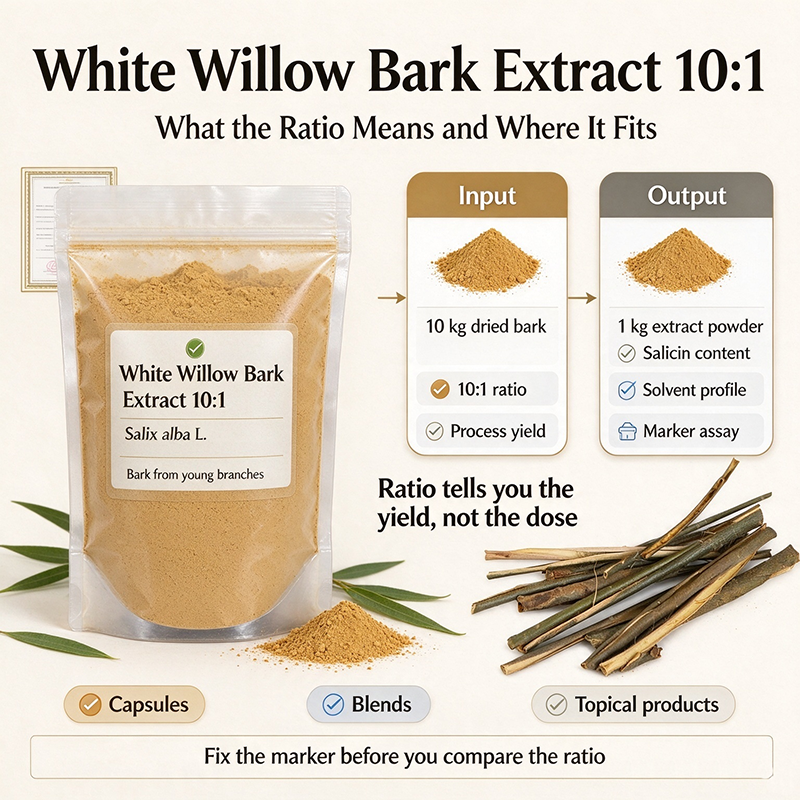
The number is a drug–extract ratio, borrowed from herbal pharmacopoeial practice: it states that ten parts of dried bark yielded one part of extract. It is a mass balance, and it is a statement about the process, not about the material.
That distinction is easy to lose because the same label sits on products of very different strength. A standardized willow bark extract is sold on its salicin content — 15%, 25%, 98% — because salicin is the marker you are paying for. A 10:1 extract is sold on its yield. Both are legitimate; they answer different questions. Ratio grades are bought for a broader "whole bark" positioning and a lower price point per kilo; marker grades are bought when the formula needs a number it can dose against.
The clinical and regulatory literature makes the same point in reverse. The EU herbal monograph for willow bark describes preparations in terms of both a ratio band and a marker content — a dry extract in roughly the 8–14:1 range, standardized to about 15% total salicin. Even the medicinal-grade standard refuses to define the material by ratio alone. When a specification gives you only "10:1", the marker has been left open, and the decision about what is in the drum has been handed to the extraction process.
Extraction is where a ratio stops being informative. The solvent decides which families of compounds come through — water pulls more of the polar phenolics and sugars, ethanol pulls a different and often richer phenolic fraction. Temperature and technique shift it again. A 2023 study on Salix alba bark compared aqueous and ethanolic extracts made by microwave-assisted and ultrasound-assisted extraction against conventional solid–liquid extraction. The ethanolic microwave extract carried the highest phenolic, tannin and flavonoid content of the set, and its antioxidant capacity (IC₅₀ 12 µg/mL by DPPH) beat the conventional extract (22 µg/mL) by a wide margin — from the same species, the same bark, and the same nominal ratio.
Raw material adds a second layer. Species matters, and in willow it matters a lot: the pharmacopoeial literature expects bark with a salicin content of at least 1.5%, while white willow bark itself runs closer to 0.5% in some sources. Bark age, harvest season and stem diameter all move the starting point. Blending or switching lots to hit a price produces a different extract inside the same "10:1" label.
The practical conclusion is not that ratio grades are bad — it is that a ratio grade needs a marker on the certificate even more than a standardized grade does, because the ratio gives you no fallback number. Ask for the salicin assay by HPLC with the method named, and read the result as your dosing basis regardless of what the drum says.
Physically, a 10:1 willow bark extract is a fine powder — typically milled to pass 80 mesh — in colours that run from brown-yellow to near-white depending on the carrier and the degree of refinement. It carries a characteristic woody odour and an astringent, slightly bitter taste, both of which come from the same tannin and phenolic fraction that makes the extract interesting in the first place. It is extracted with water and ethanol, and it is partially soluble rather than freely soluble: in water it disperses, colours the solution, and can leave sediment on standing.
That solubility behaviour, not the ratio, is what dictates which formats are easy and which are hard. A 2018 formulation study on Salicis cortex extract makes the point cleanly: to get the extract into an oral liquid in a usable concentration, the authors had to build a microemulsion (triacetin as oil, Tween 20 with labrasol as the surfactant pair, water), reaching a transparent system with droplets around 40 nm and a maximum extract loading of 40 mg/mL. That is the honest baseline. If your product is a clear drink, you are not adding a powder — you are engineering a delivery system, and the ratio on the drum is the least of your variables.
The table below maps the five formats that account for most white willow bark extract volume, with the reason each one works and the item to confirm before you commit a purchase order. Rows are ordered from easiest to hardest.
| Application | Why 10:1 suits it | What to confirm first |
|---|---|---|
| Hard capsules and tablets | An 80-mesh powder flows and compresses predictably, and a ratio grade keeps the dose per capsule economical at the low end of the market | Bulk density and flow, salicin per capsule calculated from the assay, loss on drying so the fill weight stays stable |
| Powder blends and stick packs | A dry matrix needs no solubility at all; the astringent taste can be masked by the blend rather than solved | Taste and colour consistency lot to lot, particle size against the other components, whether a carrier was used in the extract |
| Herbal blends and infusion formats | The extract is a concentrate of what an infusion would deliver, in a fraction of the mass and volume | Mesh size, microbial limits, foreign matter, and a clear statement of what the extract was standardized against |
| Topical cosmetic | Listed in the EU cosmetic ingredient inventory as Salix Alba Bark Extract (CAS 84082-82-6) with astringent, skin conditioning, hair conditioning, soothing and tonic functions; an aqueous-ethanolic extract fits toners, gels and scalp products | Exact INCI name for your grade, colour impact in a clear base, preservative efficacy, and the salicylate declaration your safety assessor will ask for |
| Clear and ready-to-drink beverages | Possible, but only with a solubilisation step — the extract alone disperses and settles rather than dissolving | Clarity and sediment over shelf life, bitterness at the target dose, pH tolerance, and whether a delivery system is acceptable on your label |
Willow bark is one of the few botanicals where the same drum can be a food supplement in one market and a herbal medicine in another, and the paperwork follows the category rather than the powder. In the EU, willow bark is the subject of a herbal monograph that defines the preparations it covers, restricts use to adults, and caps continuous use at four weeks. That monograph is written for Salix purpurea, S. daphnoides and S. fragilis — S. alba, the species on a "white willow bark" drum, is not named among them. If your market plan depends on a medicinal positioning, that gap is a question for your regulatory team before it turns into a sourcing problem.
The opposite is equally true. If you are formulating a food supplement, a cosmetic or a beverage, the medicinal monograph is not your rulebook at all — you are under food or cosmetic law, with its own requirements on what may be claimed and what must be declared. The practical consequence for sourcing is direct: choose the category first, then write the specification. The same 10:1 powder will need a different certificate, a different assay emphasis and a different label if it is going into a capsule in one country and a toner in another.
Salicin is the reason this ingredient gets attention, and it is also the reason it carries obligations. The USP safety review of willow bark summarises the position plainly: trials using 120–240 mg salicin per day for up to eight weeks reported no serious adverse effects, with gastrointestinal complaints the most common and occasional allergic reactions; there is a bleeding risk in susceptible individuals, salicylates cross the placenta, people with aspirin sensitivity are at risk, and children should not be given salicylate-containing products. The same review notes that 240 mg of salicin can yield up to 113 mg of salicylic acid in the body — and that dietary supplements are not required to carry the warnings that low-dose aspirin is legally obliged to print.
For a formulator, this converts into three concrete tasks: know the salicin content per unit dose, know which warnings your market requires on pack, and decide who the product is not for before the artwork is approved. None of that is a marketing question, and all of it is cheaper to settle at the specification stage than after a launch.
If you take one thing from this page, make it the question list. A willow bark extract quote is only comparable to another quote when these items are on the table:
A ratio tells you the extract was made. A salicin figure tells you what you are dosing. The second one is the specification; the first is the label.
Ceres Biotech supplies botanical extracts for the supplement, food and cosmetic industries, including white willow bark extract in ratio and standardized grades. If you are working through the questions above — solvent, marker, mesh, or the category your market requires — we are glad to talk it through: contact our team.