• Alice Wang
• Whatsapp: +8613379289277
• Email: info@ceresherb.com
• Products Categories: Dietary Supplement Ingredients

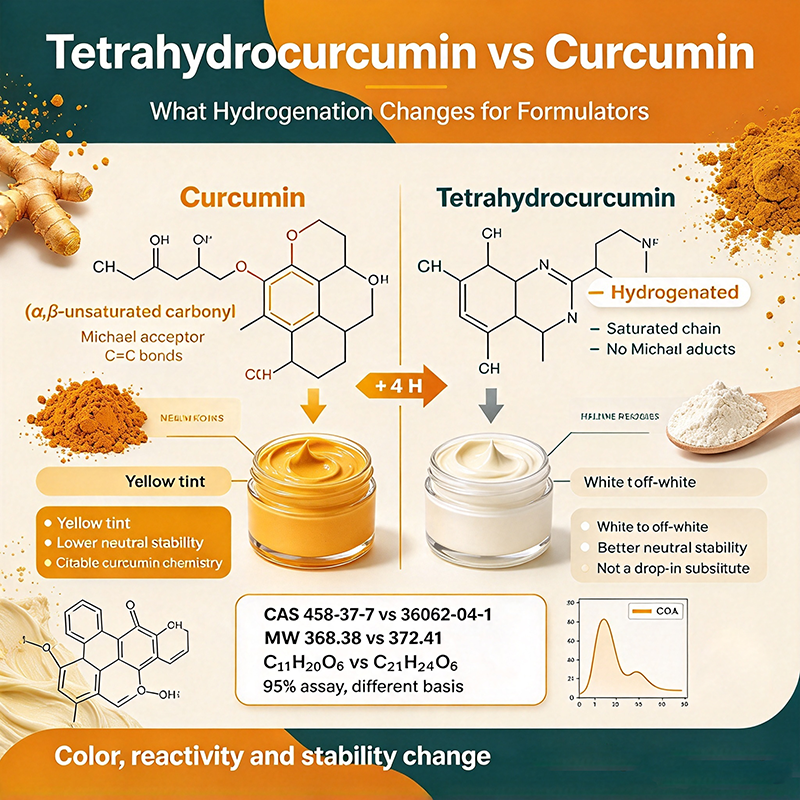
The two names get used as if they were grades of the same ingredient. They are not. Tetrahydrocurcumin is curcumin with two double bonds reduced — four hydrogen atoms added, a different molecular weight, a different color, and a different set of chemical reactions it can take part in. If you are choosing between them for a formula, the decision starts with that structural difference, not with a label claim.
Curcumin is the diarylheptanoid that gives turmeric its color: CAS 458-37-7, molecular formula C21H20O6, molecular weight 368.38. Tetrahydrocurcumin is its hydrogenated counterpart: CAS 36062-04-1, formula C21H24O6, molecular weight 372.41 (Trivedi et al., 2020; PubMed 32923007).
That 4.03 Da gap is the whole story. Two carbon–carbon double bonds in the heptane chain have been saturated. The aromatic rings and the central β-diketone are still there — which is why the two molecules share a name and a structural family — but the vinylogous chain between them is no longer conjugated.
The double bonds are not decorative. In curcumin they create an α,β-unsaturated carbonyl system, which behaves as a Michael acceptor: it reacts with nucleophiles, including thiol and amine groups on proteins. The published comparison is explicit — tetrahydrocurcumin lacks the α,β-unsaturated carbonyl moiety, and as a consequence it is unable to form Michael adducts with intracellular proteins (Aggarwal et al., 2015; PubMed 25547723; Trivedi et al., 2020).
Two practical outcomes follow from the same structural fact:
This cuts both ways, and honest sourcing means saying so: if the chemistry you want is the Michael-acceptor reactivity, tetrahydrocurcumin is not a drop-in substitute. The literature is also not unanimous on antioxidant potency — some studies rank curcumin higher, others rank tetrahydrocurcumin higher on glutathione peroxidase, glutathione-S-transferase and quinone reductase induction (Aggarwal et al., 2015). Regard both molecules as distinct ingredients, because that is what they are.
This is where the two molecules separate in a real formula. The characterisation study states that tetrahydrocurcumin is more hydrophilic and more stable than curcumin in 0.1 M phosphate buffers at various pH values, and that unlike curcumin it remains stable in the intestine and retains antioxidant activity at neutral or basic pH (Trivedi et al., 2020; PubMed 32923007). Independent work reports the same direction at pH 7.2 and 37 °C (Majeed et al., 2019; PubMed 30766658).
Why it matters commercially: curcumin is well known to degrade faster as pH moves away from acidic, which is exactly the range most creams, serums, gels and beverages sit in. If your formula is neutral and your shelf life is 24–36 months, the choice between the two is partly a stability decision, not only a color decision. Thermal data published for the powder puts tetrahydrocurcumin stable up to about 335 °C, with a melting point near 92.6 °C (Trivedi et al., 2020) — comfortably above any processing temperature you will use in a cosmetic or food line.
Here is the comparison as it should appear on the specification you receive — chemistry on the left, what it means for your line on the right.
| Item | Curcumin 95% | Tetrahydrocurcumin 95% |
|---|---|---|
| CAS number | 458-37-7 | 36062-04-1 |
| Molecular formula | C21H20O6 | C21H24O6 |
| Molecular weight | 368.38 | 372.41 |
| Appearance | Orange-yellow powder | White to off-white powder |
| Assay | Curcuminoids ≥ 95% (HPLC) | Tetrahydrocurcumin ≥ 95% (HPLC) |
| α,β-unsaturated carbonyl | Present — Michael acceptor | Absent — no Michael adducts |
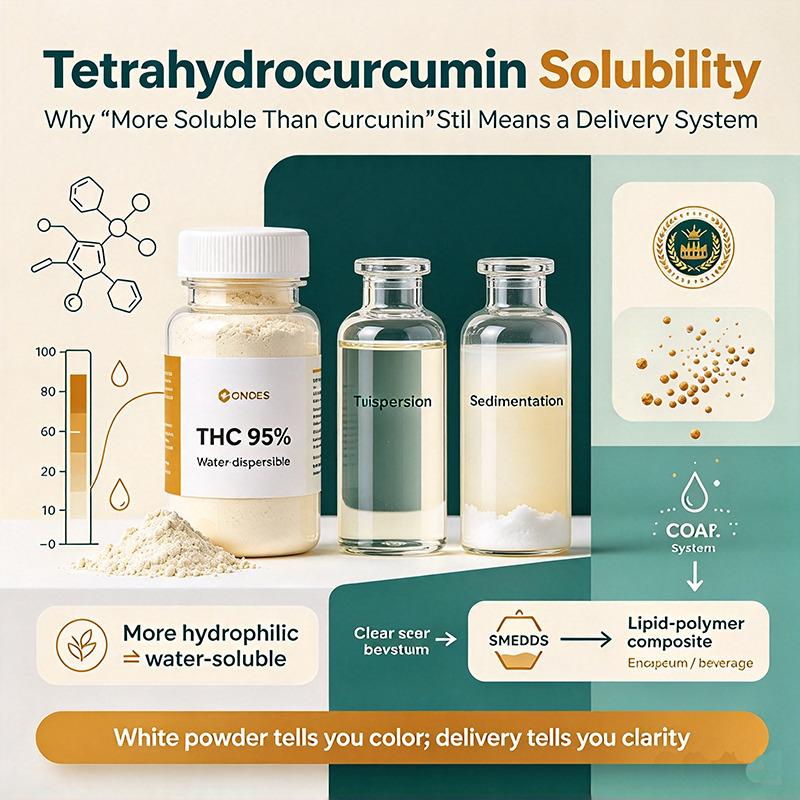
| Water solubility | Neither water- nor oil-soluble | Insoluble in water; soluble in acetone, ethyl acetate, chloroform, IPA |
| Stability in neutral buffer | Degrades faster as pH rises | More stable across pH in 0.1 M phosphate buffer |
| Color impact on base | Tints white and clear bases yellow | No color contribution |
Two rows in that table are worth pausing on. First, water solubility does not improve: both are effectively insoluble in water, so a colorless product still needs a dispersion or delivery route. Second, the assay is not interchangeable — "curcumin 95%" means ≥95% total curcuminoids, while "tetrahydrocurcumin 95%" means ≥95% of the reduced molecule. A COA that says only "turmeric extract" tells you neither.
The yellow is acceptable or wanted — a capsule, a softgel, a golden-toned beverage, an amber serum where the color is part of the product story — and the Michael-acceptor chemistry is the reason you are using curcumin in the first place. This is the molecule the wider literature is built on, so it is also the easier one to match against published work.
The base must stay white or clear, the pH sits near neutral, or the shelf life is long. White creams, clear gels, masks, light-colored beverages and any product where a yellow cast on skin or packaging is a complaint all point to the reduced form. Our tetrahydrocurcumin powder page covers the powder grade.
A brand can carry both across a range — curcumin where color is not a constraint, tetrahydrocurcumin where it is. What you cannot do is swap one for the other mid-project without re-checking three things: the label name, the assay basis on the COA, and every study you cited in the marketing file. The two names describe two different molecules, and reviewers of your artwork will notice.
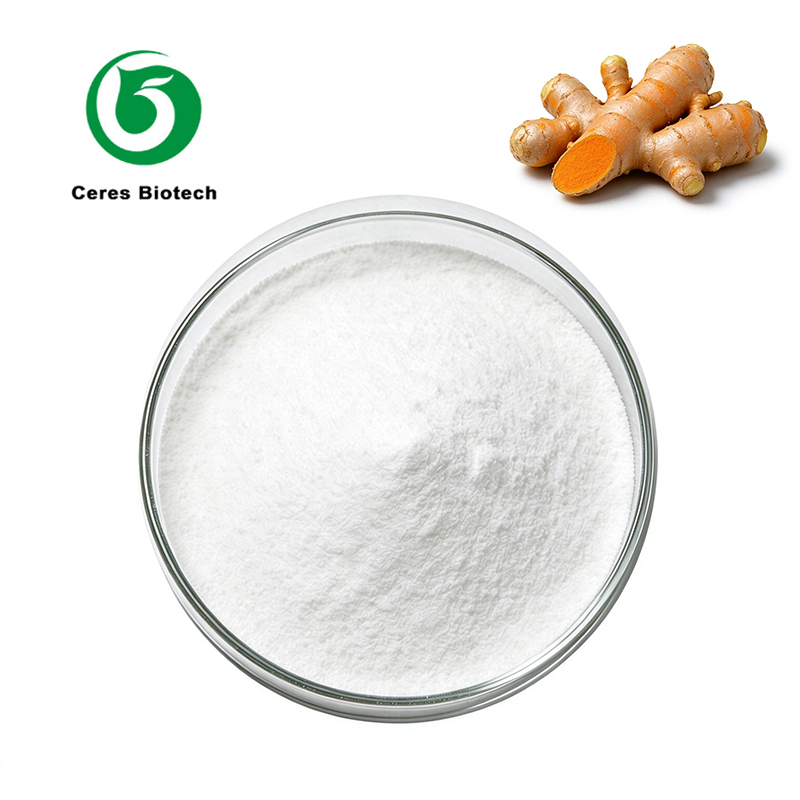
White to off-white powder, ≥95% assay (HPLC), CAS 36062-04-1. Saturated chain with no α,β-unsaturated carbonyl. For white creams, clear gels and light-colored beverages.
View product & spec →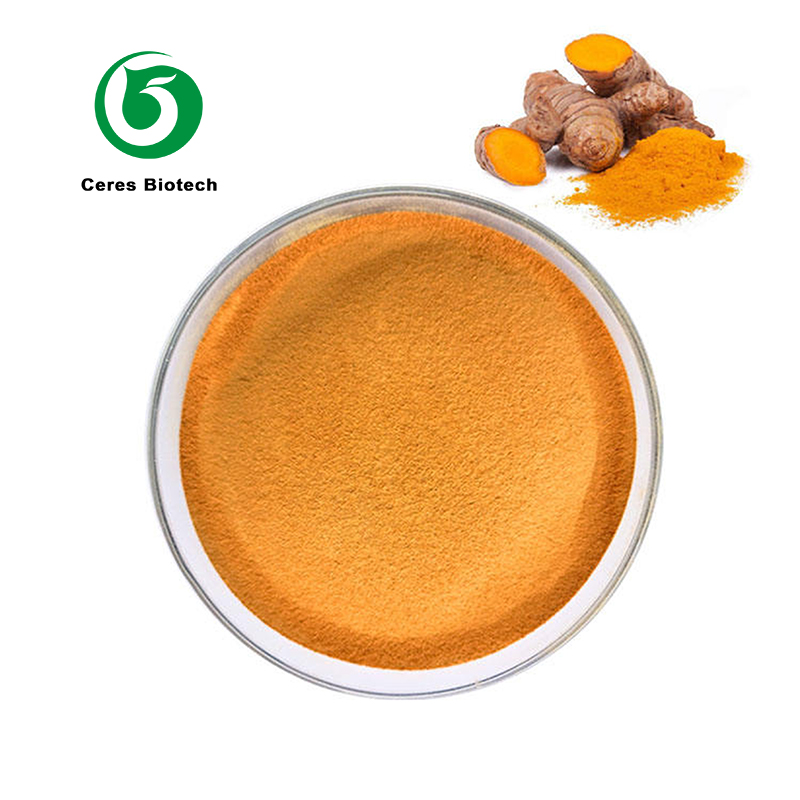
Orange-yellow powder, total curcuminoids ≥95% (HPLC), CAS 458-37-7, 100% pass 80 mesh. For capsules, softgels and formats where the golden color is part of the product.
View product & spec →As a China-based supplier of both grades, we supply curcumin 95% and tetrahydrocurcumin 95% with a per-batch COA. Send us your RFQ and tell us which molecule you need, your target assay and your format — white cream, clear gel, light-colored beverage or capsule — and we will return a specification you can formulate against. If you are still deciding between the two, send both briefs and we will quote each on its own line.
Request a sample or quote →Full COA and MSDS per batch, flexible MOQ and competitive pricing available — request a sample or quote. (Factory audits, certifications and pricing are handled separately and do not define product activity.)