• Alice Wang
• Whatsapp: +8613379289277
• Email: info@ceresherb.com
• Products Categories: Dietary Supplement Ingredients

Every second enquiry about tetrahydrocurcumin ends with the same question: can it go into a clear aqueous serum or a clear beverage? The honest answer starts with a distinction most spec sheets blur — tetrahydrocurcumin solubility is better than curcumin's, and it is still not water-soluble. Here is what the data actually says, and which formats need a delivery system.
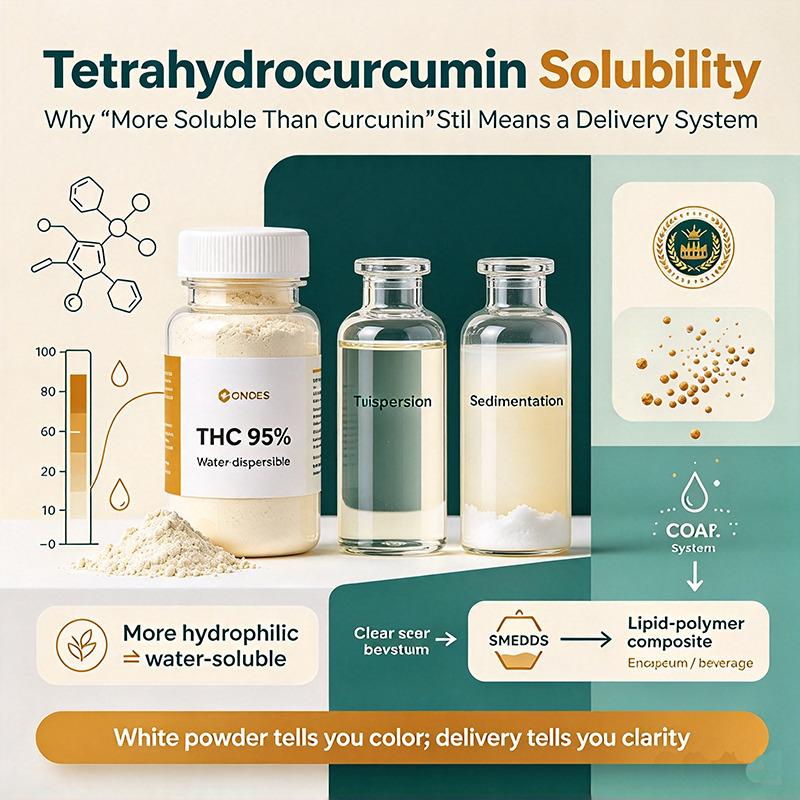
The powder is white, the specification says 95%, and the word "hydrophilic" appears somewhere in the marketing. Put those three together and it is easy to conclude that the material dissolves in water. It does not follow. White is a colour, 95% is an assay, and "more hydrophilic" is a comparison — none of them is a solubility figure.
This matters commercially because the failure shows up late. A formulator specifies the powder into a clear gel, the batch comes out hazy or drops sediment on standing, and the launch slips while someone reformulates. That is an expensive way to learn a physical constant.
The comparison comes from the characterisation literature, which states that THC is more hydrophilic and more stable than curcumin in 0.1 M phosphate buffers at various pH values (Trivedi et al., 2020; PubMed 32923007). Read that sentence carefully: it tells you the direction of the difference between two molecules. It does not tell you the absolute number for either one.
A relative statement is not a specification. If curcumin is very poorly soluble in water and THC is somewhat less poorly soluble, both can still sit far below the concentration your formula needs. "Better than curcumin" has sold a lot of projects into a haze problem for exactly this reason.
Published work on the isolated material describes THC as insoluble in water, and soluble in acetone, ethyl acetate, chloroform and isopropanol (Majeed et al., 2019; PubMed 30766658). That is the qualitative position, and it is the one to hold on to.
For an order of magnitude, third-party data sheets for tetrahydrocurcumin commonly quote water solubility at around 0.1 mg/mL — read that as a planning figure from published data sheets, not as a release specification, because it will vary with crystal form, particle size and method. Even taken at face value it describes a material that needs roughly ten litres of water to dissolve a single gram. No clear beverage is built on that.
Here is the distinction that resolves most of the confusion. Our own 95% grade is specified as water-dispersible — the powder wets out and suspends evenly in an aqueous system. Dispersible is not soluble. In a dispersion the substance is still solid; you have made small particles, not molecules. In a true solution the substance has left the solid state entirely.
Practically, that decides the appearance of your finished product. A dispersion scatters light, so it reads hazy to opaque, and it can settle or cream over shelf life depending on viscosity and particle size. A true solution is clear and stays clear. If your brief says "clear", dispersibility does not get you there.
Formulation scientists have not ignored this. Published approaches show what it takes to move THC from "poorly soluble" towards something a body can absorb — and each should be read as evidence that the base molecule needs help, not as evidence that your powder will behave that way on its own.
| Approach | System studied | What was measured | Reported result |
|---|---|---|---|
| Unformulated powder (reference) | Plain THC, no carrier | Permeability across Caco-2 monolayers | Baseline for the comparison below |
| Self-microemulsifying system (SMEDDS) | Liquid SMEDDS and a floating tablet; droplet 33.9 ± 1.0 nm in aqueous media | Permeability across Caco-2 monolayers; release | About 3–5× higher than unformulated THC; ~72% released over 12 h; stable 6 months under intermediate and accelerated conditions |
| GRAS lipid–polymer composite | Electrospun composite of gelatin, MCT and lecithin that self-assembles into an emulsion on contact with water | Encapsulation, release profile, lipid digestion | Carried a water-insoluble load using only food-grade materials and gave a relatively linear release profile |
Note what these routes have in common: each changes the physical state of the material — emulsified, or encapsulated in a lipid matrix — before any performance gain appears. None of them improves the molecule's intrinsic solubility. That is the whole point.
One more number puts the scale in perspective. THC is a Biopharmaceutical Classification System Class II compound — low solubility, high permeability — and a validated dissolution method for it had to use a surfactant-containing medium to reach sink conditions; adding sodium lauryl sulfate raised solubility by roughly 17-fold (Mohamed Ebrahim et al., 2021; PubMed 34719154). When a seventeen-fold surfactant boost is what it takes to run a standard release test in a laboratory, a plain powder stirred into water is not a delivery strategy.
This is the hardest brief. A dispersion will read hazy in a clear pack, and haze is visible to your customer before any benefit is. You need a genuine solubilisation step — a microemulsion, a carrier system, or a development project that starts before the batch is scaled. Ask for the appearance of the finished base, not just the appearance of the powder.
Same constraint, plus stability over shelf life. A "water-dispersible" grade that suits an opaque protein shake will not automatically suit a clear functional drink. Test turbidity and sedimentation at your real dose, at your real pH, for your real shelf life.
More forgiving, because the system already contains an oil phase and an interface. Whether THC partitions into the oil or sits as dispersed solids depends on your process and surfactant system — this is a bench question, not a catalogue question.
The easiest brief, and the one where dispersibility is entirely sufficient. Solid dosage forms do not need a clear solution; they need content uniformity, which is a blending and particle-size question rather than a solubility one.
The full material specification sits on our tetrahydrocurcumin 95% grade page; the powder grade is listed here. If you are still deciding whether you need the reduced molecule at all, the trade-offs between the two molecules are covered in our tetrahydrocurcumin and curcumin comparison.
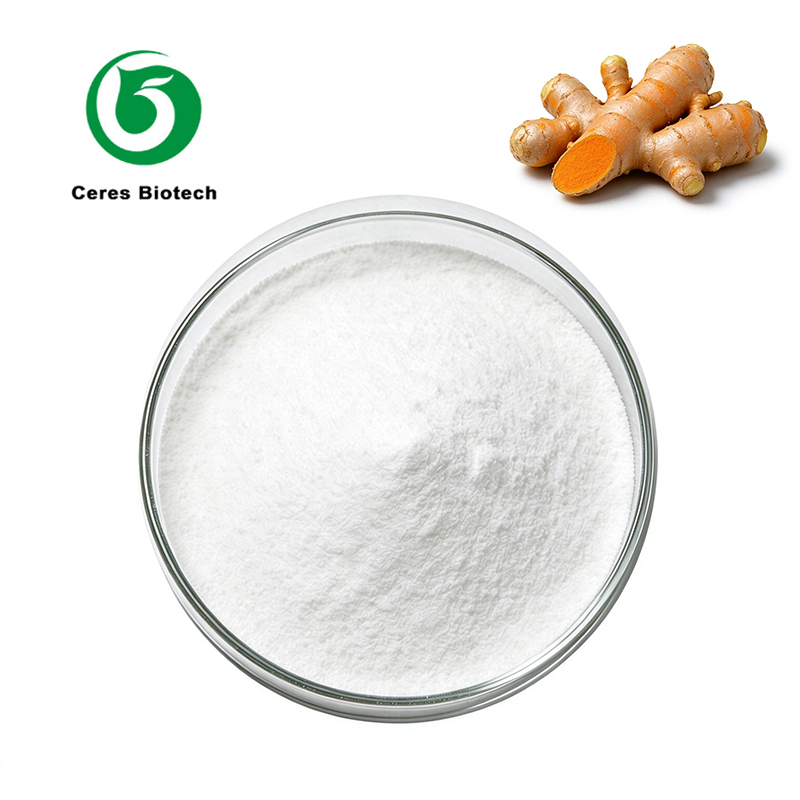
White to off-white powder, ≥95% assay (HPLC), CAS 36062-04-1. Soluble in ethanol, methanol and DMSO; water-dispersible. 100% pass 80 mesh, per-lot COA.
View product & spec →As a China-based supplier of tetrahydrocurcumin, we supply the 95% white grade with a per-batch COA and the dispersion data you need before you scale. Send us your RFQ and tell us your format — clear serum, beverage, emulsion or capsule — plus your target dose and pH, and we will return a specification and a dispersion note you can test against.
Request a sample or quote →Full COA and MSDS per batch, flexible MOQ and competitive pricing available — request a sample or quote. (Factory audits, certifications and pricing are handled separately and do not define product activity.)