• Alice Wang
• Whatsapp: +8613379289277
• Email: info@ceresherb.com
• Products Categories: Dietary Supplement Ingredients

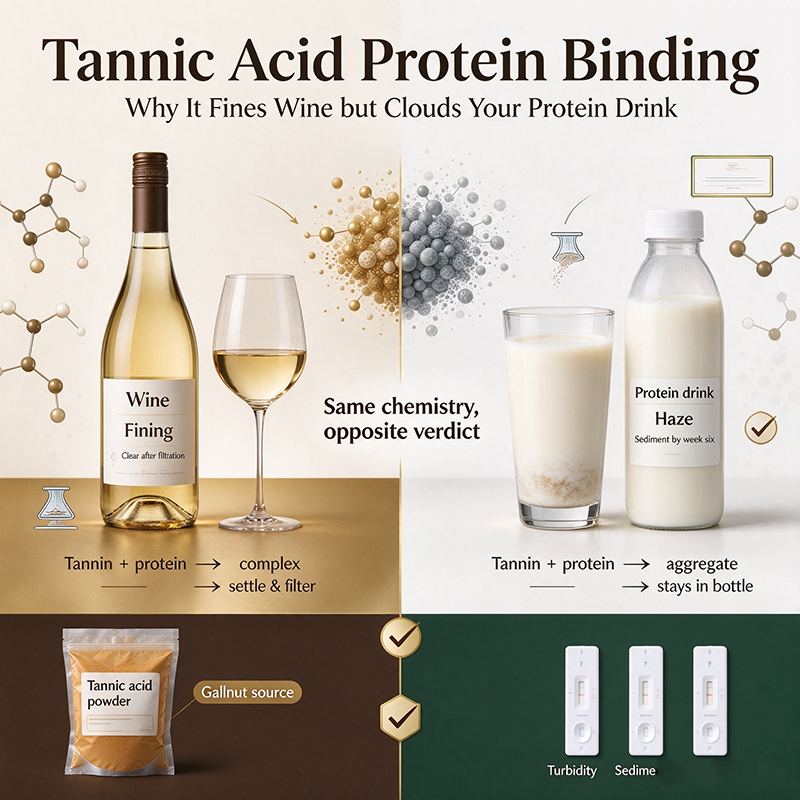
Tannic acid protein binding is the single reaction that decides whether this powder is an asset or a defect in your formula. In a young white wine it removes the proteins that would otherwise turn the bottle cloudy in a cold cellar. In a milk tea, a soy drink or a collagen shot, the identical reaction produces the haze and the sediment your customer photographs. Same molecule, same chemistry, opposite verdict.
Nothing looks wrong at the bench. The powder dissolves — our grade is specified for instantaneous water solubility, so it goes into solution fast and clean — the drink is bright, the pH is in range, and the batch ships. Then it sits in a warm warehouse or a cold truck, and the report comes back with a photograph: a ring of fine sediment, or a general dullness that was not there on the day of filling.
This lag is why the failure keeps reaching the market. Protein binding is not an instant chemical incompatibility that throws a warning at the mixing tank. It builds. Small soluble complexes form first, they keep growing as the two partners find each other, and only when the aggregates pass a certain size do you see them as turbidity. Cold accelerates the process in most beverage systems, which is exactly why the fault is labelled "chill haze" in brewing and winemaking and "tea cream" in the ready-to-drink tea industry.
Tannic acid, the gallotannin we extract from Chinese gallnut, is a polygalloyl glucose — one glucose core wearing several Gallic Acid esters. Those galloyl groups carry plenty of hydroxyls, and hydroxyls are what proteins and water both respond to.
The mechanics are less obvious than the old textbook picture of a tannin grabbing a protein. A 2025 study combining molecular dynamics with NMR found that tannins bind through water molecules rather than directly to the protein surface, and that the sites rich in protein–tannin hydrogen bonds coincide with the sites where the NMR signals shift; the authors link those bonds to subsequent protein–protein association and aggregation (Yoshimura et al., 2025; PubMed 40749475). In plain terms: the tannin changes the water layer around the protein, the protein becomes willing to meet other proteins, and an aggregate is born. The tannin does not have to stay glued to the final particle to have caused it.
That detail matters to you practically, because it means the reaction depends on concentration, temperature, pH and time rather than on a hard yes/no compatibility rule. A dose that behaves in a stabilised, pasteurised, thick system can misbehave in a thin, cold, long-shelf-life one.
In winemaking, tannic acid is added as a fining agent. Its protein-binding tendency is recruited to collect the grape proteins that are prone to denature on chilling, so the aggregate can be settled and filtered before bottling. The incumbent practice is bentonite, and it is not free: the same 2025 study that used tannic acid to strip haze proteins from Sauvignon Blanc and Petit Manseng notes that bentonite carries high cost, sizeable wine losses and adsorbs aroma and flavour compounds (Wang et al., 2025; PubMed 40467215). That is the commercial logic of tannic acid in a cellar — you are buying selectivity, and you accept the loss of a little volume in exchange for keeping more of the aroma.
A beverage plant has no such step. There is no settling tank, no filter, no racking. When you put a tannin into a protein-containing drink, the aggregate you create is a permanent ingredient. Nobody downstream takes it out.
Ready-to-drink tea is the best-documented example, because the industry has fought this for years. Cold-induced creaming is described as a persistent bottleneck, and recent work identified the plant protein RuBisCO as a key component of tea cream: EGCG drove macroscopic aggregation and unfolded the protein, clearly outperforming epicatechin, caffeine, galacturonic acid and theanine, through a dual route of multidentate noncovalent bridging plus oxidative cross-linking of cysteines by quinones (Wang et al., 2026; PubMed 42915859). Read that as a warning about margins, not about tea. Polyphenol plus protein, in a cold chain, at scale, equals deposit.
The table below is the decision you actually have to make. The question is never "is tannic acid compatible" — it is "does my process have a step that removes what this reaction creates".
| Your matrix | What the tannin does there | Test before you scale |
|---|---|---|
| Grape wine, cider, fruit wine | Fining: collects haze-prone protein so it can settle and be filtered out. Useful action, provided filtration follows. | Chill test at cellar temperature, turbidity and thermal stability before and after fining, and a bench trial on aroma impact at your dose. |
| Beer | Chill-haze protein removal and astringency adjustment, again with a removal step downstream. | Chill-haze cycling, foam behaviour, and sensory comparison against your current fining agent. |
| Ready-to-drink tea, milk tea | Defect. Polyphenol–protein aggregation reads as cream, dullness and sediment over shelf life. | Four weeks at refrigeration temperature plus a warm/cold cycle, turbidity, and centrifuged sediment by weight. |
| Plant protein, dairy and collagen drinks | Defect. Cross-linked protein aggregates, often worse after heat processing. | Heat then chill, hold and re-check turbidity, sediment after centrifugation, and viscosity drift. |
| Protein-free systems: clear soda, candy, oral care, hard capsules | No protein partner, so this route to haze does not open. Other routes still can. | Solution colour and clarity over time, plus a check on metal ion contact in your equipment and water. |
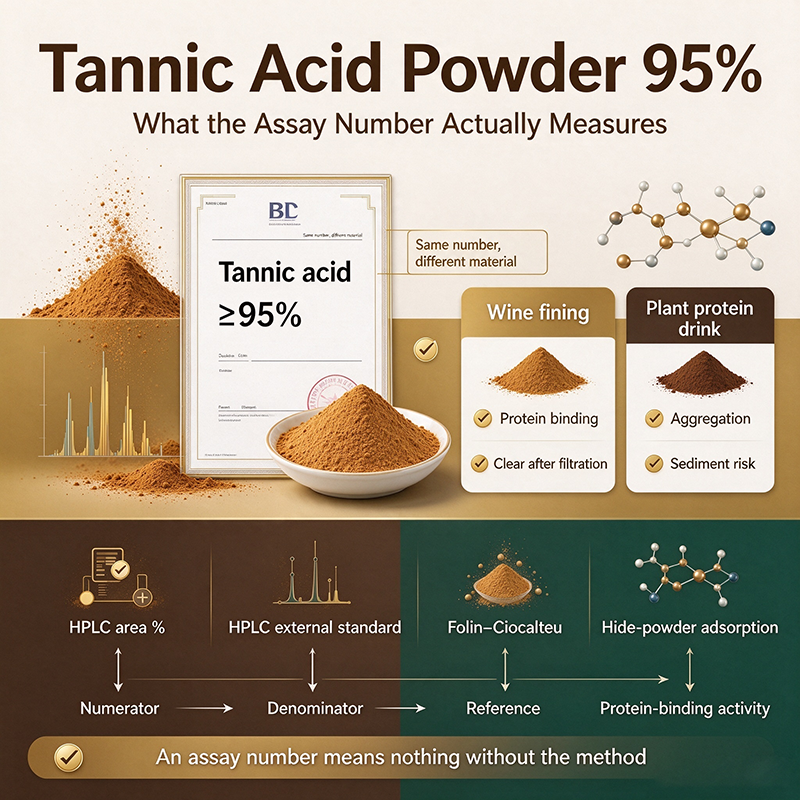
For reference, the material itself is well characterised: our food-grade gallnut tannic acid runs ≥95% by HPLC (a recent lot read 95.13%), brown powder, 100% pass 80 mesh, loss on drying 1.22% and ash 1.36%, with heavy metals under 10 ppm. It is the gallnut, not the bark or the leaf, that makes it what it is — the gall is an aphid-induced structure on Rhus chinensis in which hydrolysable tannins reach 74.5% of gall-wall dry weight, roughly 32 times the level in ungalled leaves (Lu et al., 2026; PubMed 42830535). That concentration is why a small dose is enough to matter in a formula, in either direction.
Because the powder dissolves instantly, the reaction starts instantly. That is convenient in a cellar and unforgiving in a drink. Three habits keep you out of trouble.
If this is your first trial, run it on the real matrix, not on water. Protein content, pH, ionic strength, thermal process and storage temperature all move the outcome, and a bench result in water tells you almost nothing about a drink that contains 1–3% protein and gets pasteurised.
Do not assume every deposit in a tannin-containing product is a protein complex. In grape juice and wine, a documented route to water-insoluble sediment runs through ellagic acid released when ellagitannins hydrolyse during storage. A 2002 study followed juice and wine over 50 and 120 days at 20 °C, observed the expected decline in ellagitannins with storage, and then found that no more than 12% of the sediment by weight was actually free ellagic acid; the rest was unidentified material or conjugated forms (Lee and Talcott, 2002; PubMed 12083868). Two things follow for a formulator. First, sediment can appear even when the starting concentration of the suspected culprit was low. Second, sediment analysis by guessing is unreliable — you have to look at what your deposit is actually made of before you change the formula.
The full material specification is on our food-grade gallnut tannic acid page, and the batch COA layout is shown on the 95% grade page. If your route to sediment turns out to be hydrolysis rather than protein, the downstream molecule is gallic acid, which we also supply as a 99% white powder.
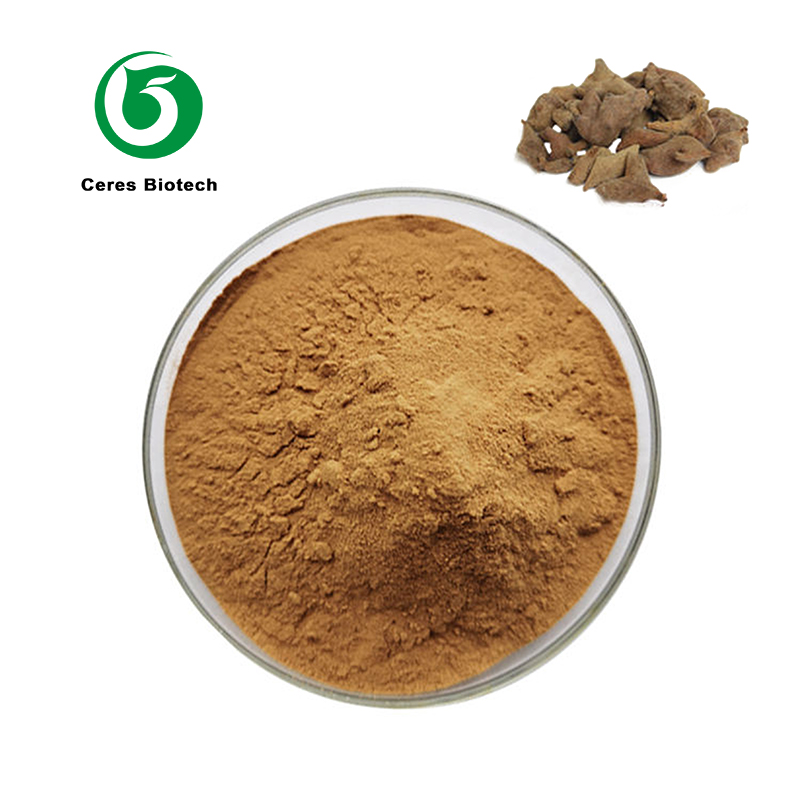
From Rhus chinensis gall, ≥95% by HPLC (lot 95.13%), brown powder, 100% pass 80 mesh, loss on drying 1.22%, ash 1.36%, heavy metals <10 ppm. Per-batch COA, Kosher and Halal available.
View product & spec →As a China-based producer of gallnut tannic acid, we supply the food-grade 95% powder with a per-batch COA. Tell us the matrix, the process and the shelf life you are designing for, and we will send a specification you can put straight into a bench trial — including the solubility and mesh data your pilot line needs.
Request a sample or quote →Full COA and MSDS per batch, flexible MOQ and competitive pricing available — request a sample or quote. (Factory audits, certifications and pricing are handled separately and do not define product activity.)