

• Alice Wang
• Whatsapp: +8613379289277
• Email: info@ceresherb.com
• Products Categories: Dietary Supplement Ingredients

Ceres Biotech manufactures and supplies magnesium supplement ingredients in every major form — magnesium glycinate, magnesium l-threonate, Magnesium Citrate, Magnesium Malate and high absorption liposomal magnesium — as magnesium powder and finished bulk material. Each grade is documented, food grade and reformulation-ready for brands building a magnesium for sleep, magnesium for energy or magnesium for muscle product line.
Three grades carrying the most formulation demand right now — the gentle glycinate for sleep, the brain-focused l-threonate, and the high-absorption liposomal magnesium glycinate.
These three products also map the commercial spectrum of the category: a gentle daily chelate, a premium cognitive salt, and an encapsulation upgrade that answers the absorption question. Most successful magnesium lines are not a single SKU but a small family built around distinct benefits, which is why Ceres stocks the full ladder rather than one hero ingredient.
 Sleep
 Brain High Absorb
Glycinate remains the volume workhorse because it is forgiving on the gut and easy to dose, while l-threonate commands a premium on cognition positioning and liposomal grades differentiate on absorption. Together they give a new brand three credible entry points without committing to the full ladder on day one.
Eight magnesium grades spanning glycinate, l-threonate, citrate, malate and the liposomal line — all food grade, available in bulk with OEM support.
Having the full set in one catalogue simplifies assortment planning. A brand can ladder from an entry glycinate, through citrate and malate for energy, up to l-threonate and the liposomal line for premium positioning — all sourced, documented and shipped from a single supplier with consistent quality.
Glycinate Threonate Citrate Malate Liposomal Liposomal Liposomal Liposomal Ordering the range this way also helps with storytelling: lead with the gentle daily glycinate, then show the energising malate and the cognitive l-threonate, and finish with the liposomal upgrades. Buyers move naturally from an easy first purchase to a premium repeat, and the catalogue reads as a considered system rather than a random list of salts.
Magnesium is the second most searched supplement ingredient in the United States, and formulation interest is accelerating as consumers learn about magnesium deficiency and the wide magnesium benefits across sleep, energy and mood.
Modern diets, processed food and stress all erode magnesium status, which is why magnesium deficiency is now a mainstream wellness concern rather than a niche clinical topic. Brands respond by adding a magnesium supplement to sleep, calm, energy and sports recovery lines, and by upgrading from cheap magnesium oxide to better-tolerated, better-absorbed forms such as glycinate, citrate and l-threonate. That shift is the core driver behind the strong magnesium supplement market growth shown below.
Ceres Biotech supports this demand with a full ladder of forms and a liposomal magnesium line that answers the single biggest buyer question — how do you make magnesium actually absorb. Whether you need magnesium powder for capsules or a finished high absorption magnesium bulk grade, the supply chain is built for scale.
Magnesium sits at the centre of human biochemistry. It is a required cofactor for more than 300 enzymes, stabilises ATP — the cellular energy currency — and regulates the NMDA receptors that control nerve excitation. When intracellular magnesium runs low, muscles stay tighter, sleep is lighter and stress feels heavier, which is exactly why a daily magnesium supplement appears across so many product categories. For formulators this is an advantage: one mineral supports sleep, energy, mood and recovery claims, so a single magnesium line can anchor several SKUs.
Regional demand is also shifting. North America remains the largest market by search and retail volume, but Europe and parts of Asia are climbing quickly as clean-label and sleep-health trends spread. Buyers increasingly ask for specific forms by name rather than a generic mineral, pushing manufacturers to stock glycinate, citrate, malate and l-threonate side by side instead of defaulting to cheap oxide.
Global magnesium supplement market, 2024–2030 (USD billion). Estimated compound annual growth rate about 9.8%.
The growth curve is not just bigger volume but richer mixes. As consumers learn that not all magnesium is equal, they trade up from grocery-store oxide to specialist forms, lifting both unit price and margin for brands that stock the right grades. That upgrade cycle is the structural reason magnesium stays a priority category for formulators year after year.
The magnesium form you choose decides the benefit profile. Match the salt to the claim — sleep, brain, digestion or energy.
Choosing the right salt is the single most important specification decision in any magnesium product. The anion attached to the mineral changes how it tastes, how gently it sits in the gut, and which benefit claim it can credibly carry. The four cards below map the most commercial forms to their primary job.
The chelated, gentle salt behind most magnesium for sleep and magnesium for anxiety formulas. Magnesium glycinate benefits include high tolerance and minimal laxative effect. Pairs with magnesium and sleep, magnesium glycinate sleep, magnesium for stress and magnesium for relaxation positioning.
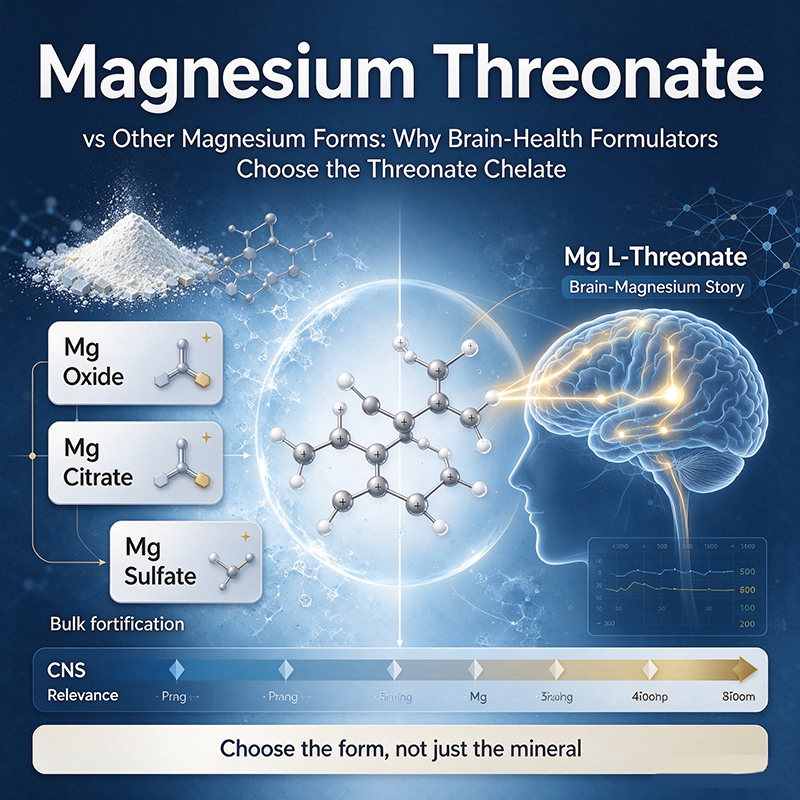
The form most linked to magnesium for brain support, with magnesium l-threonate brain research behind it. Magnesium threonate benefits centre on cognition and focus, making it the premium nootropic magnesium l-threonate choice.
A well-absorbed, mildly osmotic salt behind magnesium citrate benefits and gentle magnesium for constipation support. Often blended as magnesium citrate malate to balance taste, tolerance and uptake.
Malic acid-bound magnesium built for magnesium for energy and magnesium for muscle performance, plus magnesium for leg cramps support in sports and evening formulas. A favourite in fatigue and recovery stacks.
Beyond these four, specialty salts such as taurate and sulfate serve cardiovascular and topical niches, and blends like magnesium citrate malate bridge categories. The practical rule is to start from the claim you want to make, then pick the form that supports it with the fewest compromises on taste, tolerance and cost.
Life-stage positioning also follows the form map. Prenatal and older-adult formulas lean glycinate for tolerance, sports and weekend-warrior products lean malate for energy, and student or professional focus lines lean l-threonate. Mapping each SKU to a form and a clear user keeps the line coherent and makes later liposomal upgrades feel like a natural step up rather than a different product.
Low intake is common, and the early signs map directly onto the most popular magnesium supplement claims.
A magnesium deficiency rarely shows up as a single dramatic symptom. Instead it appears as tired muscles, poor sleep, low mood and sugar cravings — which is exactly why magnesium for leg cramps, magnesium for migraine, magnesium for pms and magnesium for pregnancy are such high-intent searches. Athletes lose magnesium through sweat, older adults absorb less, and anyone on diuretics or high-caffeine routines runs a deficit.
The body also relies on magnesium for magnesium for heart rhythm steadiness and magnesium for bones, since roughly half of total body magnesium sits in bone alongside calcium. A daily magnesium supplement is therefore a foundational stack component — not a fad. The practical question is which form and what magnesium dosage suits the user, covered in the sections below.
Dietary magnesium comes mainly from leafy greens, nuts, seeds, legumes and whole grains, but modern food processing and lower produce mineral density mean many people fall short without noticing. Fortified foods and a magnesium supplement close the gap, and because the early signs are vague, the safest approach for most brands is a steady daily dose of a well-absorbed form rather than occasional high doses that upset the stomach.
Certain groups need more attention. Endurance athletes lose magnesium through sweat, older adults absorb less and produce less stomach acid needed for uptake, and people on diuretics, acid-reducing drugs or high-caffeine routines run a chronic deficit. Pregnancy raises requirements too, which is why magnesium for pregnancy is a recurring request from prenatal brands building a complete line.
Confirming a shortfall is straightforward: a clinician can test red-blood-cell magnesium or serum magnesium alongside related electrolytes, though mild deficits often show up in how a person feels before they show up in a lab. For a brand, the takeaway is reassurance rather than alarm — a daily, well-absorbed magnesium supplement is a low-risk way for most people to support the systems that matter, which is exactly why the category stays in demand.
Sleep and relaxation lead, but muscle, energy, bone and mood formulas form a large and growing base.
Indicative share of magnesium supplement end-use demand, 2025. Sleep and relaxation lead at 31%, followed by muscle and energy at 24%.
The demand split matters for assortment planning. Sleep and relaxation is the largest pool, but muscle, energy, bone and mood together are larger still, which is why a magnesium line should rarely be a single SKU. Stocking glycinate for calm, malate for energy and l-threonate for cognition lets a brand cover the whole map from one supplier, and pair each with the right botanical or liposomal active for a stronger story.
For a private-label launch, this split also informs minimum viable assortment: a glycinate for calm, a malate for energy, and a l-threonate for cognition already cover the three largest pools and leave room to extend into liposomal and combination SKUs once the line proves out. Starting narrow but complete beats launching a dozen me-too capsules.
The single largest reason buyers search for a magnesium supplement is a better night's rest and a calmer day.
Magnesium for sleep works through GABA and parasympathetic calming pathways, which is why magnesium and sleep is such a strong pairing claim and why magnesium glycinate sleep formulas dominate the evening-aid shelf. For daytime calm, magnesium for anxiety, magnesium for stress and magnesium for relaxation all draw on the same neuromuscular easing effect, with glycinate and threonate the preferred forms.
A magnesium supplement for sleep is typically taken 30–60 minutes before bed, often stacked with L-theanine, GABA or 5-HTP for a broader relaxation effect. Brands building this stack can source the magnesium glycinate powder base from Ceres and combine it with our liposomal and botanical line — a complete magnesium for sleep and anxiety raw-material solution from one supplier.
The mechanism behind magnesium for sleep and magnesium for anxiety is increasingly well described. Magnesium binds to GABA receptors and dampens overactive NMDA signalling, quieting the nervous system without sedation, while also supporting healthy cortisol rhythms. That is why glycinate and threonate are favoured in evening formulas, and why they pair naturally with L-theanine or GABA in a broader relaxation stack.
For the brand, the sleep and calm segment is also the easiest to merchandise: it sits next to melatonin, ashwagandha and valerian on the shelf, all of which Ceres supplies as bulk actives. A magnesium plus botanical bundle reduces formulation complexity and gives the buyer a ready-made relaxation system rather than a single isolated ingredient.
Dose framing matters in this segment. Rather than promising dramatic effects, the credible angle is steady, nightly support: calmer evenings, easier wind-down, and better recovery. That positioning also aligns with how magnesium actually works — as a daily moderator of the nervous system, not a sedative — and it keeps claims within defensible structure-function language that regulators and retailers accept.
Our liposomal line answers the toughest buyer objection — how do you make magnesium actually absorb without stomach upset.
Liposomal magnesium encapsulates the mineral in phospholipid vesicles, protecting it through the stomach and improving uptake versus standard salts. The result is high absorption magnesium that is gentle enough for sensitive users. Our liposomal magnesium glycinate and liposomal magnesium malate grades carry the bisglycinate and malate benefits into a premium, bioavailable format.
For formulators, high absorption magnesium glycinate means smaller serving sizes and fewer digestive complaints — a cleaner label story. All grades are available as liposomal magnesium bulk supply with full documentation, making it straightforward to launch a differentiated liposomal magnesium SKU without building liposome know-how in-house.
Standard salts dissolve in the acidic stomach and can precipitate or irritate before reaching the small intestine, where most uptake happens. Liposome encapsulation shelters the mineral in a phospholipid shell, improving survival through the stomach and supporting absorption lower in the gut. The practical payoff is a high absorption magnesium claim that survives scrutiny, with fewer digestive complaints that otherwise drive negative reviews.
Ceres builds its liposomal magnesium glycinate and liposomal magnesium malate grades on the same liposome platform used across the wider liposomal line, so a brand can extend from magnesium into liposomal vitamin and botanical actives without re-qualifying a new supplier. That consistency is what makes a multi-SKU liposomal range viable for smaller teams.
A practical note for label claims: liposomal delivery is a structural advantage, not a license to overstate. Keep structure-function language defensible, cite the form and the dose, and let the gentler tolerance and smaller serving size carry the message. Buyers respond to honest, specific claims far more than inflated ones, especially in a category where review sites now scrutinise absorption promises.
Form decide tolerance and uptake. Understanding magnesium supplement types helps you pick the right base for the claim.
A typical adult magnesium dosage sits around 300–420 mg of elemental magnesium per day, split across meals to protect the gut. Magnesium absorption varies sharply by form: cheap magnesium oxide is only about 4% absorbed, while magnesium citrate, magnesium glycinate (or magnesium bisglycinate) and magnesium l-threonate absorb far better. Magnesium sulfate and magnesium taurate round out the clinical toolkit for topical and cardiovascular-support uses respectively.
When comparing magnesium supplement types, the trade-off is simple: oxide is cheap but poorly used, citrate is well absorbed with a mild laxative edge, glycinate is gentle and calming, malate is energising, and l-threonate is the brain-focused premium. Magnesium l-threonate dosage is usually lower because more reaches target tissue. Formulators sometimes blend salts — for instance magnesium glycinate malate — to combine calm and energy benefits in one serving. The comparison table below makes the choice concrete.
Two numbers matter on a specification sheet: elemental magnesium and total compound weight. A 500 mg magnesium glycinate tablet may deliver only about 50 mg of elemental magnesium, so dose claims must be stated as elemental. Timing also helps — splitting the magnesium dosage across meals improves tolerance, and taking it away from high-calcium meals can improve uptake for sensitive users.
Stacking is where magnesium shines. Combined with vitamin D3 and K2 it supports bone strategy, with B6 it aids nervous-system calm, and with taurate it leans cardiovascular. Because magnesium absorption varies so much by form, the smart formulation move is to lead with a well-absorbed salt and let the supporting actives do the rest, rather than overloading a single cheap mineral.
For brands specifying a product, the form also dictates the delivery format. Glycinate and citrate flow well in capsules and tablets; malate suits stick packs and drink mixes; l-threonate is often dosed low in small capsules or sachets. Matching the salt to the format avoids manufacturing surprises and keeps the finished product stable on shelf across its labelled life.
A quick reference for specifiers choosing a magnesium base by absorption, tolerance and best-fit claim.
| Form | Absorption | Tolerance | Best for | Notes |
|---|---|---|---|---|
| Magnesium oxide | Low (~4%) | Can irritate | Occasional use, price-led | Cheapest bulk form; poor uptake limits efficacy |
| Magnesium citrate | Medium-high | Mild laxative | Digestion, general top-up | Often blended as magnesium citrate malate for balance |
| Magnesium glycinate / bisglycinate | High | Very gentle | Sleep, calm, daily | Preferred magnesium for sleep and relaxation base |
| Magnesium malate | High | Gentle | Energy, muscle, recovery | Malic acid supports cellular energy pathways |
| Magnesium l-threonate | High (to tissue) | Gentle | Brain, focus, cognition | Premium magnesium for brain nootropic form |
| Magnesium taurate | Medium-high | Gentle | Heart, mood support | Taurine synergises on cardiovascular calm |
| Magnesium sulfate | Topical / oral | Use-specific | Soaks, occasional | Epsom salt form; not for daily oral bulk |
For most finished magnesium supplement lines, glycinate, citrate, malate and l-threonate cover the four dominant claims: sleep, digestion, energy and brain.
The table makes the trade-offs explicit: oxide wins on price but loses on usefulness, citrate is the balanced all-rounder, glycinate is the calm-and-sleep workhorse, malate is the energy pick, and l-threonate is the premium brain form. Taurate and sulfate remain valuable for specific cardiovascular and topical uses. Matching the salt to the claim is what separates a credible magnesium supplement from a generic one, and it is the first thing an educated buyer checks on the label.
For sourcing, the table doubles as a supplier scorecard. Ask each candidate for the forms they actually stock, the elemental percentage of each, and the documentation behind it. A supplier holding glycinate, citrate, malate, l-threonate and the liposomal line under one roof removes the coordination overhead of managing several vendors and keeps quality consistent across your whole magnesium range.
Every magnesium powder ships with the paperwork B2B buyers require — COA, specification and traceability.
As a magnesium supplement manufacturer and magnesium supplement supplier, Ceres Biotech treats documentation as part of the product. Each food grade magnesium lot is tested for identity, heavy metals, microbials and assay, with a full COA on file. Our food grade magnesium glycinate and other salts are produced under controlled GMP-style processes suitable for capsules, tablets, sticks and ready-to-mix powders.
Traceability matters for buyers building a compliant magnesium supplement line, so every magnesium powder grade is lot-coded and supported by stability data. Whether you need a single salt or a full form ladder, the documentation package travels with the material.
Beyond the certificate, buyers should ask about particle size, bulk density and flow — properties that decide whether a magnesium powder fills capsules cleanly or sticks in a blender. Ceres Biotech controls these during manufacturing and reports them on the spec sheet, so downstream production teams can plan tooling and dosing with confidence rather than reworking a batch after it arrives.
Regulatory fit is the other half of quality. Each food grade magnesium grade is supplied with MSDS, allergen statements and country-of-origin documentation, and can be accompanied by organic or kosher certificates on request. For brands selling into the EU, UK or North America, that paperwork is what turns a raw material into a launch-ready ingredient.
Stability is the quiet test of quality. A food grade magnesium powder should hold assay and colour across its labelled shelf life under normal storage, and Ceres validates this with accelerated and real-time stability data on request. For finished products, that evidence supports shelf-life claims and protects against returns — a detail that matters more as retailers tighten specification requirements.
Qualified mineral and amino-acid feedstocks, incoming-tested before any reaction or chelation step.
Controlled glycination and liposome encapsulation for high absorption magnesium grades.
COA, specification and stability on every food grade magnesium lot before release.
Scale from pilot to container with consistent grades and private-label support.
Ceres Biotech supplies magnesium glycinate bulk, magnesium citrate bulk and magnesium powder bulk across pilot, production and container volumes. Our magnesium supplement wholesale and wholesale magnesium supplement programs cover magnesium glycinate wholesale alongside liposomal and l-threonate grades, all available as bulk magnesium glycinate powder, magnesium glycinate powder bulk and bulk magnesium citrate powder.
For brands, we offer magnesium supplement oem and magnesium private label with format flexibility — capsules, sachets, tablets or straight magnesium citrate powder supplement and magnesium l-threonate powder 99 raw material. Magnesium bisglycinate bulk and finished magnesium l-threonate supplement grades round out a one-stop magnesium sourcing plan.
Operational details decide whether a launch stays on schedule. Typical lead time is 7–15 working days for stocked food grade magnesium grades and 3–4 weeks for custom blends or liposomal lots. Material ships in 25 kg fibre drums or foil bags, with cold-chain avoided for dry powders, and full documentation — COA, specification, MSDS and lot traceability — travels with every order so regulatory teams can file without delay.
Pricing scales with volume: pilot lots start at 25 kg for formula validation, production runs move to drum quantities, and container volumes unlock the lowest per-kilo cost on magnesium glycinate bulk, citrate, malate and liposomal magnesium bulk supply. Because Ceres holds the full form ladder and the liposomal line, a single annual contract can cover an entire magnesium range and simplify procurement overhead.
25 kg pilot lots, free samples for qualified enquiries, full COA shipped with every magnesium powder order.
Container-volume pricing on magnesium glycinate bulk, citrate, malate and liposomal magnesium bulk supply.
Magnesium supplement oem and magnesium private label from capsule to sachet, with your artwork and specs.
Clean-label, better-absorption and sleep-positioned products are pulling magnesium supplement growth forward.
Three trends define the current magnesium supplement market. First, clean-label buyers reject cheap, poorly absorbed salts and ask for glycinate, citrate and l-threonate by name. Second, absorption technology — especially liposomal magnesium and high absorption magnesium formats — is moving from premium niche to expected. Third, sleep and stress positioning keeps best magnesium supplement lists dominated by glycinate and threonate stacks.
For procurement teams, the practical takeaway is to qualify a magnesium supplement supplier that can deliver the full form ladder and the liposomal line from one source, with consistent food grade magnesium quality. That is exactly the gap Ceres Biotech fills for international brands.
The formulation and sourcing questions we hear most from brands building a magnesium line.
Pair magnesium with these liposomal and botanical actives for a complete relaxation and recovery stack.
These actives are the natural companions to a magnesium line. Calcium pairs with magnesium for bone and muscle balance, GABA and melatonin extend the sleep story, and 5-HTP, L-theanine and ashwagandha cover mood, focus and stress — letting a brand build a full relaxation and recovery range from one documented source.
The six picks below are available as bulk actives with the same documentation standard as the magnesium line, so a brand can prototype a stacked formula quickly. Request samples of any combination and our team will advise on compatible forms, dosing ranges and label claims to keep the finished product both compelling and compliant.
From magnesium glycinate powder to liposomal magnesium and magnesium l-threonate, source every form from one food grade, document-ready supplier. Request a sample, a spec sheet or a private-label quote today.
Request a Quote