• Alice Wang
• Whatsapp: +8613379289277
• Email: info@ceresherb.com
• Products Categories: Dietary Supplement Ingredients

Your AHK-Cu scalp serum formulation looked right at release: a clean blue-violet, no sediment, pH inside spec. Eight weeks on the stability shelf the colour has faded toward grey-lilac and a faint haze sits at the bottom of the bottle — yet the HPLC assay for the peptide peak has barely moved. That gap between what you can see and what your method reports is the whole subject of this article.
AHK-Cu is not a fragile material. Supplied at ≥99.0% by HPLC, ≥100 mg/mL soluble in water, it goes into an aqueous base at ambient temperature without a solubiliser step. That ease of handling is exactly what makes it easy to under-think.
Consider what a scalp serum physically is. It is a leave-on, water-continuous product, dosed at 0.05%–0.5% (500–5,000 ppm) of the peptide, held at a weakly acidic pH to keep the hair shaft smooth, thickened with an anionic polymer so it does not run off the scalp, and almost always carrying a hydrolysed protein for film-forming and conditioning. Every one of those decisions is correct for the product. Several of them are hostile to a copper complex. An AHK-Cu scalp serum formulation is not difficult because the ingredient is delicate — it is difficult because the formula is well built in ways that work against it.
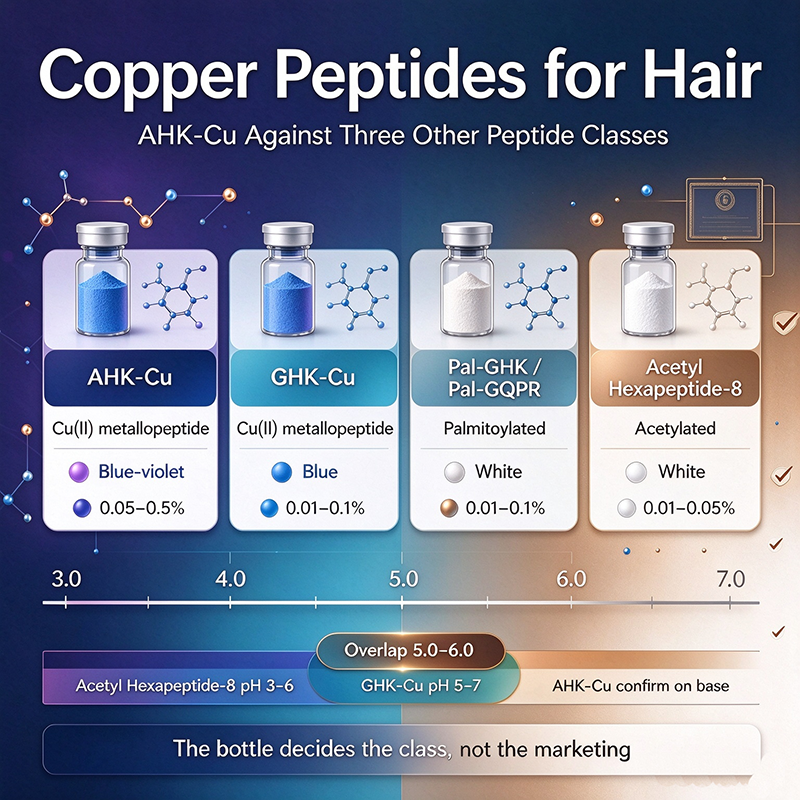
Note also the dose. Our GHK-Cu grade runs at a typical0.01%–0.1% in the water phase. AHK-Cu in hair and scalp work sits an order of magnitude higher. A higher load of copper in the same litre of water means more copper available to be captured by anything in that water that binds it better than the peptide does.
The blue-violet is a metal-centred chromophore: it is the d–d transition of copper(II) held in the peptide's nitrogen environment. Formulators read it as a health indicator, and it is a useful one — but it answers a narrower question than most people assume. It reports that copper(II) is present in a nitrogen-rich coordination environment. It does not report whether that environment is still your tripeptide.
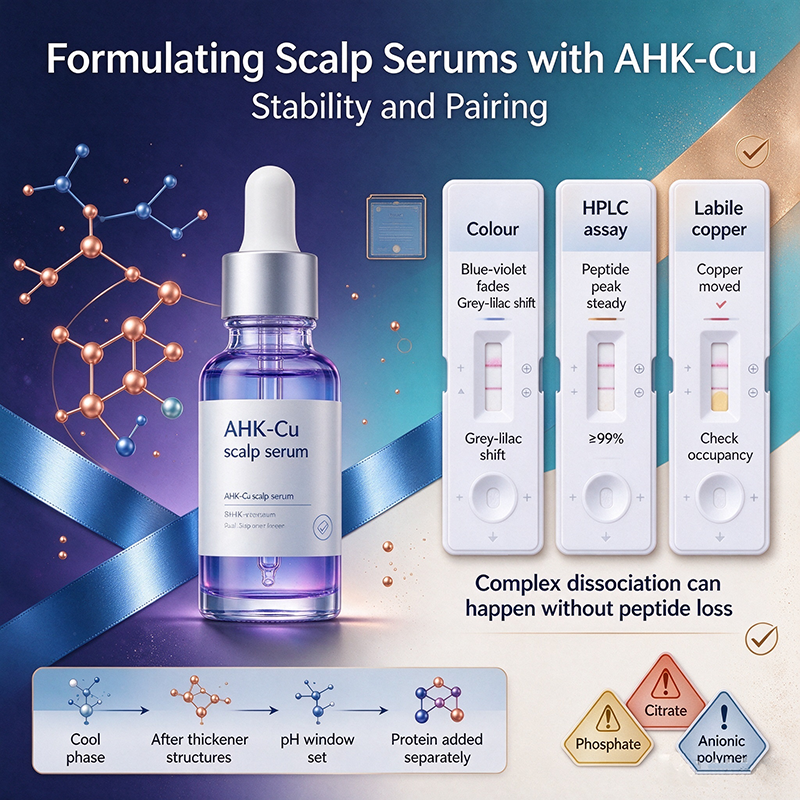
This is why the fading bottle is diagnostic rather than decorative. Colour loss or a shift toward grey means the coordination sphere around the copper has changed. The copper has not evaporated. It has moved — onto a carboxylate on your thickener, onto a histidine or cysteine residue in your hydrolysed protein, onto the walls of the container. And here is the uncomfortable part: the peptide peak on your HPLC does not move when that happens, because the peptide is still there. A 2026 systematic review of copper-peptide coordination chemistry puts it plainly: a method that reports only loss of the parent peak is insufficient, because complex dissociation can occur without peptide loss.
So the assay you filed is not wrong. It is measuring the organic half of a two-part molecule.
Copper(II) binds GHK and AHK strongly, but "strongly" is a relative word. The same review lists the ligand classes that compete with the tripeptide for its metal: phosphate, citrate, aminopolycarboxylate chelators, amino-acid buffers, anionic polymers and proteins. Read that list again against a typical scalp serum formula and you will find most of it already in the beaker.
The molar ratio is what decides it. Below, what each class does and what to do about it. These are general coordination-chemistry judgements applied to your matrix, not results from a specific test on your formula.
| Ingredient class | What it does to the copper | Practical move |
|---|---|---|
| Phosphate buffer | Phosphate is a competent copper ligand and competes directly with the peptide's imidazole nitrogen. Common in "physiological pH" templates that get carried into scalp products by habit. | Ask whether phosphate is earning its place. A citrate or an organic-acid buffer is not automatically better for copper — but phosphate brings no benefit here that justifies the extra competing ligand. |
| Citrate buffer | Aminopolycarboxylate-type chelation. Excellent at holding pH around 5, and equally willing to hold copper. | Keep buffer strength to the minimum that holds pH. A 50 mM buffer is a much larger competing-ligand pool than a 10 mM one at the same peptide load. |
| EDTA / EDTA salts | The textbook copper chelator. At sufficient molar excess it will strip copper from the peptide outright. | If EDTA is present for preservative potentiation or hard-water tolerance, check the molar ratio against your copper load before assuming the peptide still carries its metal. In many cases a lower level does the same job. |
| Anionic thickeners (carbomer, xanthan, acrylates) | Carboxylate groups on the polymer backbone exchange with peptide-bound copper. The visible result is haze, a viscosity shift, or a gel that sets differently lot to lot. | Pre-neutralise the polymer fully and let it structure before the peptide goes in. Adding peptide to a partly neutralised dispersion puts free carboxylates in direct contact with the complex. |
| Hydrolysed proteins (wheat, keratin, silk, soy) | Side chains bind copper, histidine above all — and so does the peptide backbone itself. Copper(II) is one of the few metal ions able to deprotonate a backbone amide and coordinate to its nitrogen; zinc and iron do not. A hydrolysed protein is not a passive bystander next to your copper peptide: it presents a long row of amide nitrogens and histidine residues the metal can occupy. | This is the pairing most likely to cost you the blue. Put the protein and the copper peptide in separate phases if the format allows, or accept a lower effective copper occupancy and verify it rather than assume it. |
| Amino-acid pH adjusters (arginine, Glycine) | Free amino acids are themselves copper ligands, and an amino-acid buffer appears on the review's list of competing ligands by name. | Use them for pH only if a mineral hydroxide will not do. If you need the sensory profile arginine gives, budget for it in your labile-copper check. |
| Reducing actives (ascorbic acid, thiols) | Reduce copper(II) to copper(I), which the peptide's coordination geometry does not hold the same way — and the reduced metal can drive oxidation of other ingredients in the same phase. | Do not co-locate strong reductants with the copper peptide. Separate phases, or separate products. |
| High-heat processing | Peptide-backbone hydrolysis is faster at both acid and alkaline extremes, and heat accelerates it. The complex also exchanges faster as temperature rises. | AHK-Cu is water soluble and designed for cold-process addition. Add it after the batch has cooled, not into the hot water phase. |
| Packaging and headspace | Copper adsorbs to and can leach from primary packaging; oxygen ingress, headspace volume and light transmission all shift the labile-copper trend across shelf life. | Run the container-closure question early. A stability result from a glass lab bottle does not transfer to an airless pump or a PET dropper. |
The pattern worth carrying away: the ingredients that hurt are not contaminants or mistakes. They are the ones doing the product's real work — buffering, thickening, conditioning. AHK-Cu scalp serum formulation therefore is less about protecting a delicate raw material than about deciding, deliberately, how much of the copper you are willing to hand over to the rest of the formula.
The same review sets out four routes by which a copper-peptide system changes in a finished product, and recommends assuming all four rather than testing for whichever one you suspect. They translate into plain bench language:
The review's forced-degradation recommendation is a mass balance across four pools: intact complex, apo-peptide, degradation products, and total copper. If your stability protocol reports only intact peptide, you are tracking one of four pools, and it is the one most likely to look fine.
One more line from that review deserves to be quoted rather than paraphrased, because it is a stopping rule and not a suggestion: if labile copper cannot be held within its limit across the pH range the product will actually see, the programme should change the chemistry rather than proceed on the assumption that the biology will compensate.
Sequence fixes more copper-occupancy problems than any single ingredient swap, and in an AHK-Cu scalp serum formulation it costs nothing to get right.
Add AHK-Cu to the cooled aqueous phase. Cold-process addition is what the ≥100 mg/mL water solubility is for — there is no formulation reason to expose the complex to a hot water phase, and heat speeds both hydrolysis and ligand exchange.
Fully neutralise and hydrate the anionic polymer first. Peptide added to a partly neutralised carbomer dispersion meets a forest of free carboxylates; peptide added afterwards meets a network that has already spent its charge.
Our GHK-Cu grade is documented for a pH 5.0–7.0 working window, and AHK-Cu sits in the same coordination chemistry. Set the base pH before the peptide goes in, so the complex is never the thing you titrate against. Coordination at the histidine imidazole is pH-dependent — the neutral-pH 1:1 mononuclear species with imidazole nitrogen coordination is the well-characterised one, and pushing toward the acidic end protonates that imidazole and weakens the grip. A scalp serum wants to be mildly acidic for the hair shaft; the two requirements can coexist, but only if you know where the line is.
If the formula needs a hydrolysed protein, add it after the peptide and check the result rather than the intention. This is the single pairing most likely to take your blue.
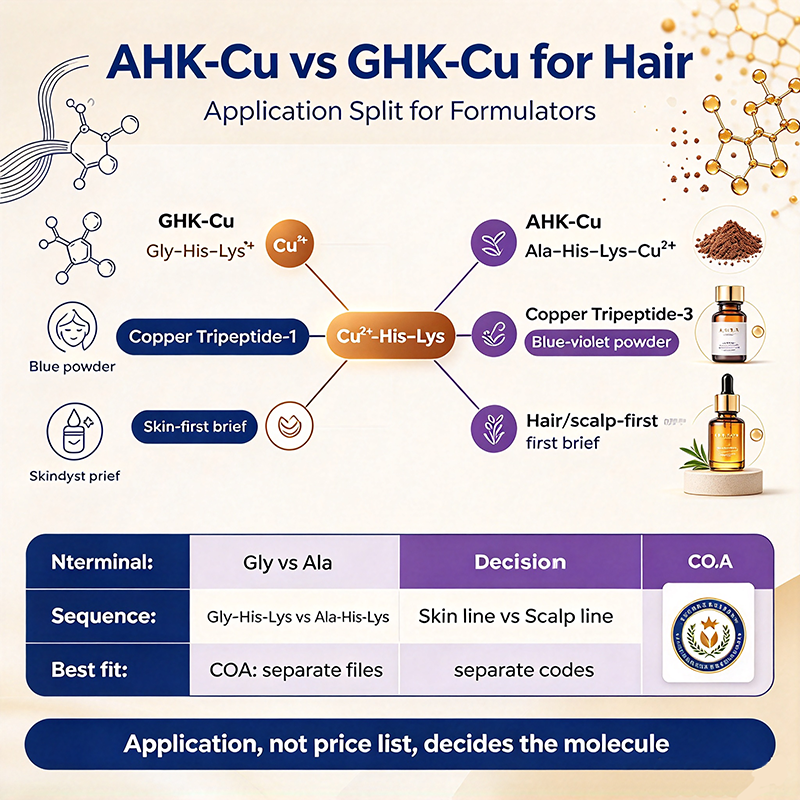
Both grades are copper tripeptides, both are blue, both are water soluble and cold-process compatible. The formulation difference is dose, and dose changes the arithmetic of every competition described above.
GHK-Cu (CAS 89030-95-5) is used at 0.01%–0.1% and carries copper at 14.5%–16.5%. AHK-Cu is used at 0.05%–0.5% with copper stated at 8.0%–12.0%. Work the two together and the scalp serum is carrying a substantially larger copper load than the facial serum built on the same bench — while also, typically, carrying more protein and more polymer. The facial formula that tolerated an EDTA level and a citrate buffer will not necessarily tolerate them at five to ten times the peptide dose.
Practical consequence: if you formulate both, do not port the preservative and chelator system across. Re-run the labile-copper question at the hair-care dose.
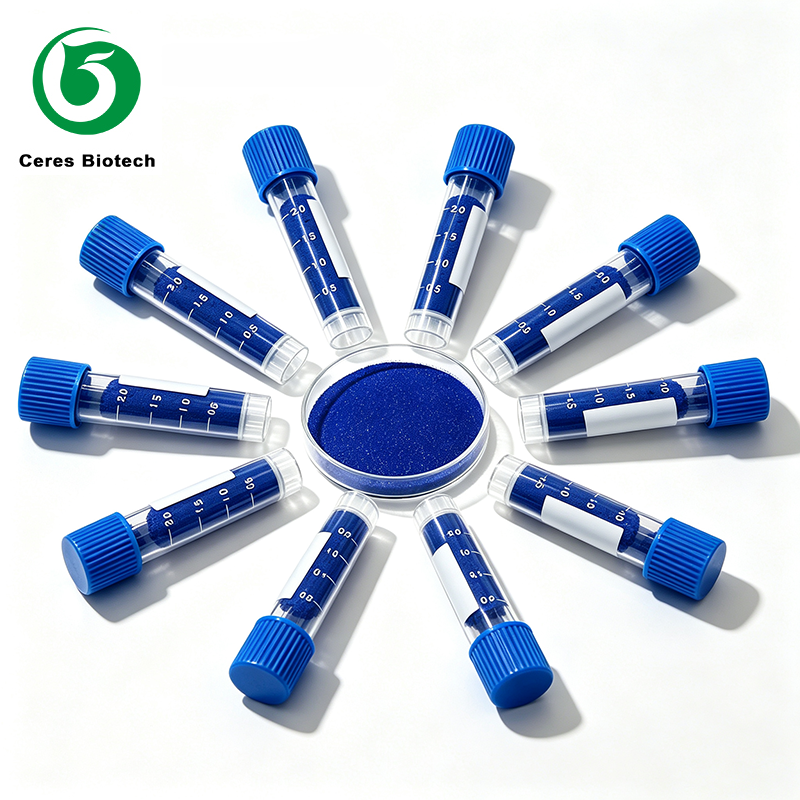
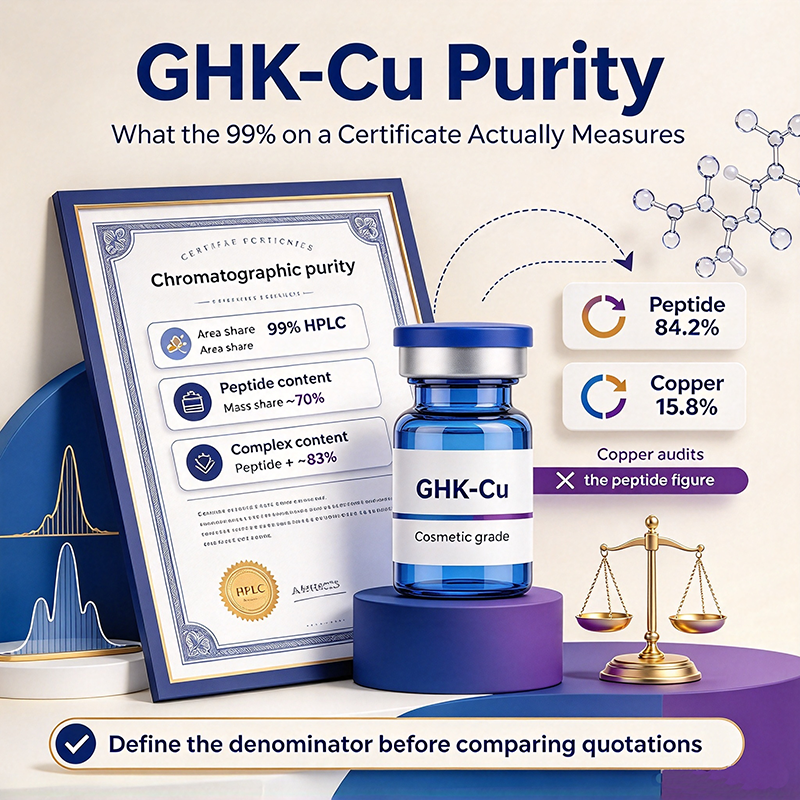
Blue to blue-violet fine powder, ≥99.0% by HPLC, Cu²⁺ 8.0–12.0%, water soluble ≥100 mg/mL. Dosed at 0.05%–0.5% in hair and scalp formats. Per-batch COA covering HPLC and MS identity.
View product & spec →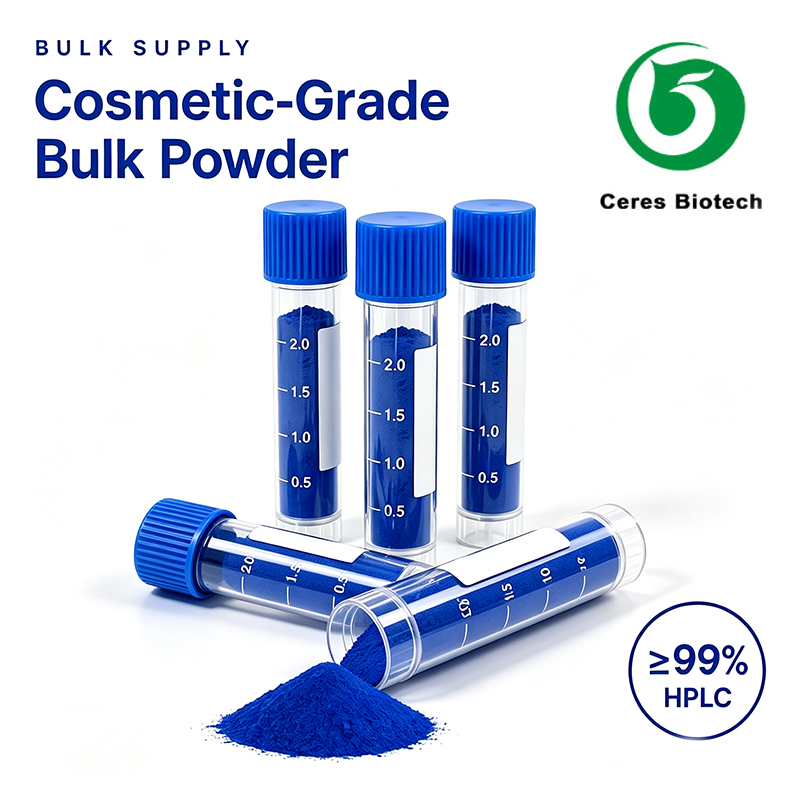
CAS 89030-95-5, blue powder, ≥99.0% by HPLC, Cu 14.5%–16.5%, fully water soluble for cold-process addition. Documented pH 5.0–7.0 working window, typical water-phase use 0.01%–0.1%.
View product & spec →Two photochemical paths run in parallel in a clear bottle: the metal-centred chromophore, and the photochemistry of the imidazole side chain. That means light exposure does not merely bleach the colour, it can alter the ligand. An amber or opaque primary pack is doing real work here, not just marketing.
Copper also adsorbs to surfaces and can leach from them. A stability study run in borosilicate lab glass will not report what an airless pump with a metal spring or a PET dropper reports, because the container is part of the system. Headspace volume matters for the same reason: less oxygen in contact with the bulk means less of the oxidation route. If your serum is opaque, airless and low-headspace, say so in the specification — those are formulation decisions that support the ingredient, and it is reasonable to ask a raw material producer to supply into them rather than around them.
On shelf life: our GHK-Cu grade is documented at 24 months under the specified storage conditions. That figure is for the powder in its pack, and it is not a promise about your finished serum. Occupancy over shelf life is a property of your matrix.
Before you freeze an AHK-Cu scalp serum formulation, separate the material question from the matrix question. The incoming document answers the first. Our AHK-Cu grade releases against HPLC purity ≥99.0%, copper content, pH, moisture and microbiology, with MS identity on the same certificate. What it cannot answer is what your base will do to that material over eight weeks — and that is the question this whole article has been circling.
Three checks worth costing into the first pilot, in order of how much they usually save:
If the certificate does not state which method produced the copper figure, that is worth a follow-up question before it is worth a purchase order. The number matters; the method is what makes the number comparable to the next lot.
As a China-based manufacturer of AHK-Cu and GHK-Cu, we supply the grade this article describes: ≥99.0% by HPLC, water soluble ≥100 mg/mL, blue to blue-violet, released with a per-batch COA that states the assay, the copper content with its method, and the MS identity of the complex. Tell us your dose level, your buffer system and your pack format when you send your RFQ — we will confirm the grade and the documentation set that fits, and send a sample for your own bench work.
Request a sample or quote →Full COA and MSDS per batch, flexible MOQ and competitive pricing available — request a sample or quote. (Factory audits, certifications and pricing are handled separately and do not define product activity.)