• Alice Wang
• Whatsapp: +8613379289277
• Email: info@ceresherb.com
• Products Categories: Dietary Supplement Ingredients

The Chinese astaxanthin market is no longer one market. For most of the past two decades, "astaxanthin" meant a single thing to domestic buyers: a pink pigment fed to farmed salmon and shrimp. That commodity tier is still dominated by synthetic astaxanthin produced from petrochemical precursors. Alongside it, a second tier has matured — natural astaxanthin cultivated from the microalga Haematococcus pluvialis — and it is now the default raw material for functional-food, nutraceutical and cosmetic brands that must stand behind a "natural" claim. The line between the two is not price. It is molecular structure.
Astaxanthin carries two chiral centers at C-3 and C-3′, which yields three stereoisomers in the all-trans configuration: (3S,3′S), (3R,3′S) and (3R,3′R). Natural astaxanthin from H. pluvialisis almost exclusively the (3S,3′S) form. Synthetic astaxanthin is a racemic mixture, typically in a 1:2:1 ratio of (3S,3′S) : (3R,3′S) : (3R,3′R) [2]. That difference is not cosmetic chemistry trivia. The (3S,3′S) isomer is shaped to insert into the lipid bilayer of cell membranes, where it inactivates excess reactive oxygen species; the (3R,3′S) and (3R,3′R) forms float freely in the cell and show markedly lower Bioavailability [2].
For a procurement team, the practical consequence is direct: a certificate of analysis that reports only "total astaxanthin %" is blind to the isomer split. Two powders can show the same total number while one is premium natural (3S,3′S-dominant) and the other a cheaper synthetic blend. The verifiable differentiator is chiral or stereochemical data on the COA, not the headline percentage.
The pink-to-red flesh of salmon is, quite literally, accumulated natural astaxanthin. A widely cited review documents astaxanthin concentration (mg/kg flesh) in wild versus farmed salmonids, with wild fish carrying the higher load because their diet is astaxanthin-rich from natural sources [1]. H. pluvialis itself concentrates astaxanthin to as much as 3.8% of dry biomass [1]. In other words, "natural source" is a measurable botanical and zoological fact, not a label claim.
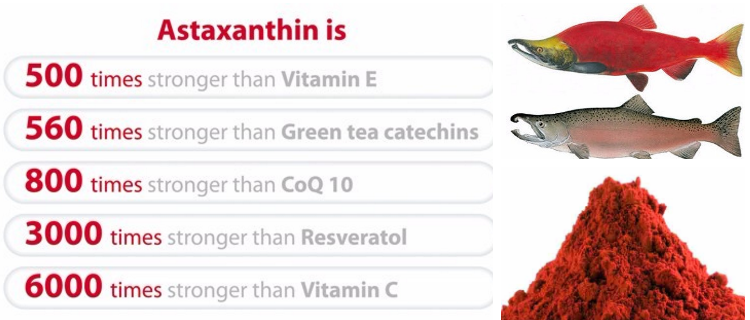
The visual contrast above — red versus grey salmon — is the clearest available illustration of why buyers pay a premium for algal-source material. The potency column on the right reflects in-vitro antioxidant assays (commonly singlet-oxygen quenching) and should be read as relative antioxidant activity, not as a clinical efficacy claim.
Synthetic astaxanthin stays competitive in aquafeed because pigmentation is its only job and cost dominates the margin math. But a brand selling an anti-aging serum or a daily antioxidant softgel cannot attach a "natural" positioning to petrochemical-derived material, and cosmetic-grade formulators in particular will not risk it. As China's functional-food and premium skincare segments expand, sourcing inquiries have shifted from "how cheap" to "how natural and how clean" — a structural move, not a fad.
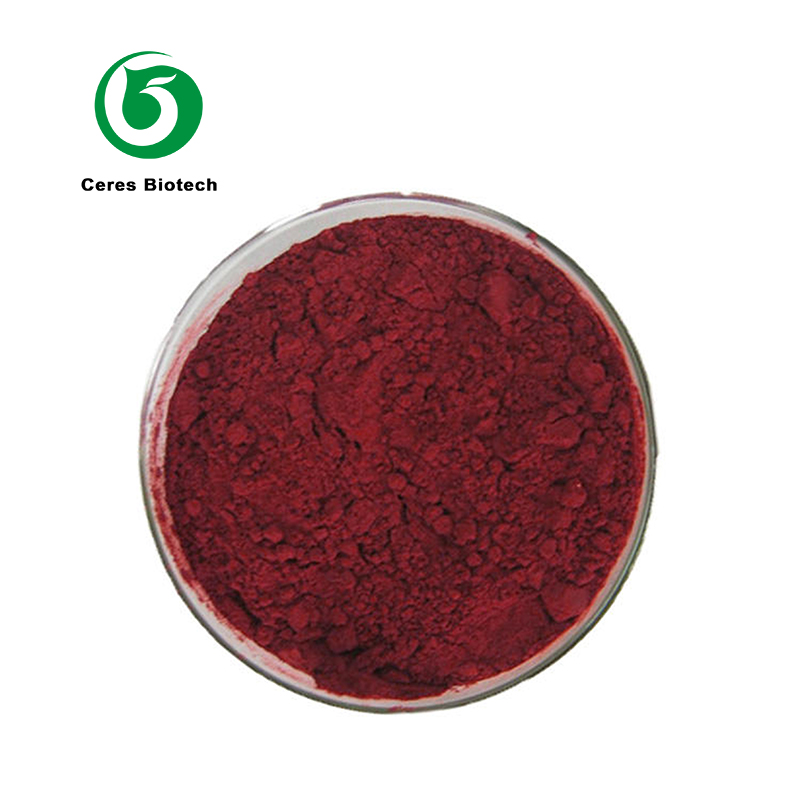
Ceres Biotech supplies natural astaxanthin extracted from H. pluvialis, never from petrochemical feedstock. Two commercial lines illustrate what a verifiable natural specification contains:
The "solvent residue: None" line matters more than it looks. Clean extraction is the operational proof that a supplier is running a natural process rather than a synthetic one with a natural label — and it is exactly the field a buyer can audit.
After reading this, a buyer can turn a vague "natural astaxanthin" into a fixed checklist:
China's astaxanthin market will keep splitting. Buyers who learn to read the isomer line, the solvent-residue line and the source line will pay for specification, not slogans.