• Alice Wang
• Whatsapp: +8613379289277
• Email: info@ceresherb.com
• Products Categories: Dietary Supplement Ingredients

When you source beta alanine, the figure that protects your formula is not our monthly tonnage but whether the powder on your line is the genuine beta-isomer — every batch. Below is exactly how we specify it, and the two products we supply to back the claim.
That distinction is the whole point of this article. Below we walk through the three product-specific facts that decide whether beta-alanine is "active" in your formula, and what a China-based supplier should put on the quote when you ask for beta alanine capacite.
Beta-alanine is not a "general amino acid." Its entire value rests on a single reaction: inside skeletal muscle it ligates with L-histidine through the enzyme carnosine synthase (CARNS1, ATP-dependent) to formcarnosine — β-alanyl-L-histidine. Carnosine is a potent intracellular buffer (its imidazole ring carries a pKa near physiological pH) that mops up hydrogen ions during high-intensity efforts of roughly 60 seconds to 4 minutes, delaying the acidosis that forces an athlete to slow. That is why beta-alanine sits in pre-workout and endurance stacks — not as a stimulant, but as a buffer precursor.
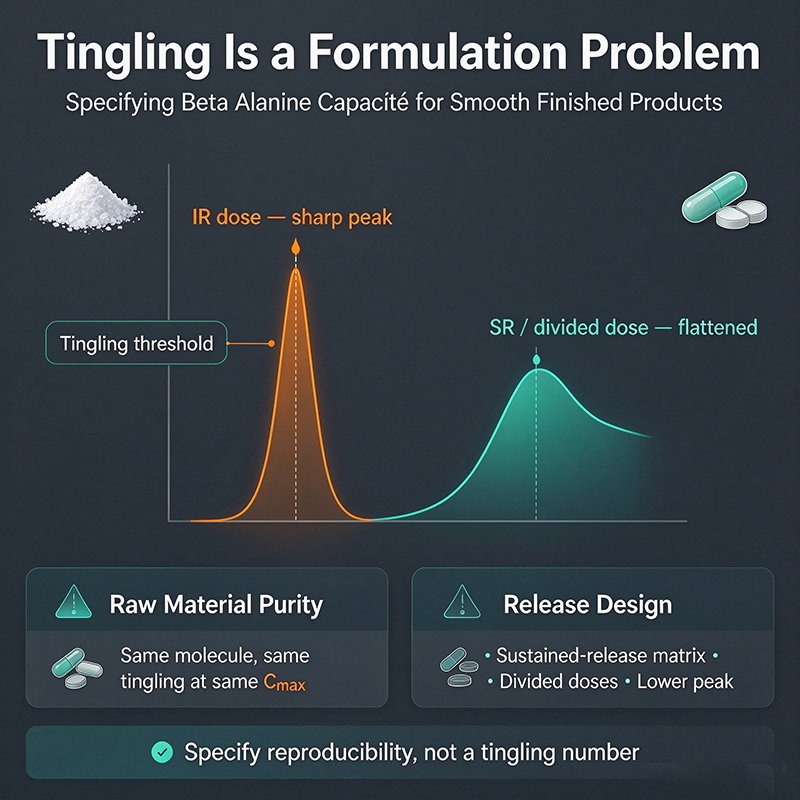
The catch for your formula is timing. Beta-alanine is the rate-limiting substrate, so a single dose does nothing visible: muscle carnosine only accumulates with chronic loading (commonly 4–6 g/day across 4–12 weeks, with measured intramuscular increases of 40–80%). So "active" beta-alanine is defined by whether it is the genuine beta-isomer your muscle can actually convert — not by a headline percentage on a spec sheet.
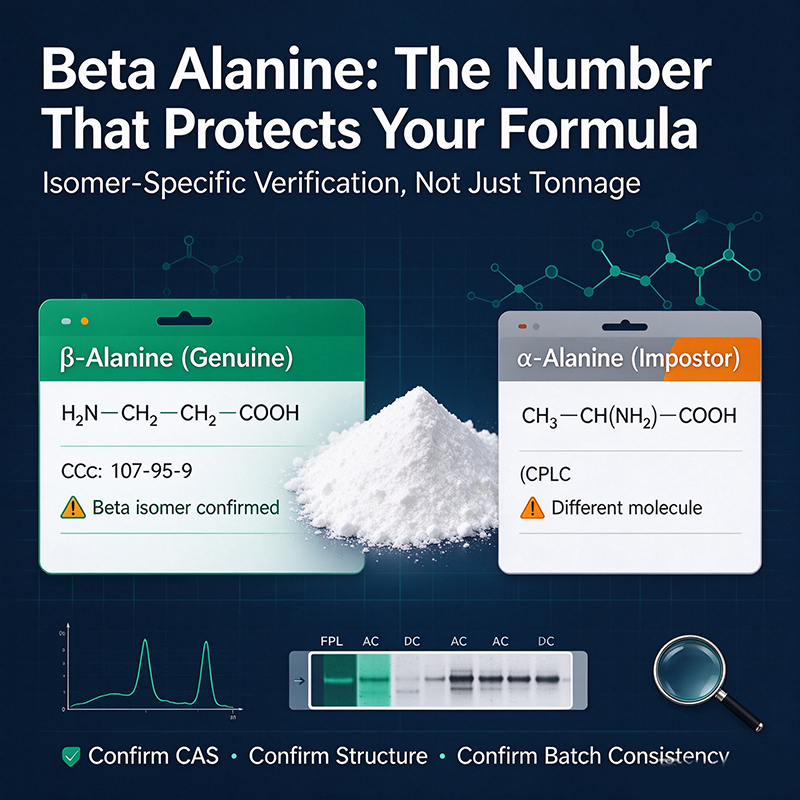
Here is the product-specific risk that generic specifications miss. Beta-alanine is NH₂–CH₂–CH₂–COOH: the amino group sits on the beta carbon, and the molecule has no chiral centre. Alpha-alanine — the ordinary proteinogenic amino acid found in every protein — is CH₃–CH(NH₂)–COOH. They are different compounds with different biochemistry, despite the shared family name.
A supplier can blend in cheaper alpha-alanine and still post "assay ≥98%" on a total-titration or total-nitrogen method that never separates the two isomers. Your finished product would then contain less of the actuaL Carnosine precursor than the label implies, and no buyer would see it from the headline number alone. The fix isisomer-specific confirmation, not a bigger assay figure: ask for a method that resolves β from α (a specific HPLC system, or a TLC that shows the beta band) and a CAS / molecular-formula match — 107-95-9, C₃H₇NO₂ — that pins the molecule. Our beta-alanine posts 98.6% by titration with TLC Conforms and the correct CAS and formula, i.e. the beta isomer rather than an alpha blend.
Because carnosine = beta-alanine + L-histidine, some brands co-dose histidine; beta-alanine remains the limiting factor, so the precursor route is sound on its own. But you have a second option: skip the in-muscle synthesis step entirely and formulate with finished L-carnosine, the dipeptide itself. Which route fits depends on your label claim, your dose form and your cost target — and we supply both the precursor and the finished dipeptide, so the choice is yours rather than a supply constraint.

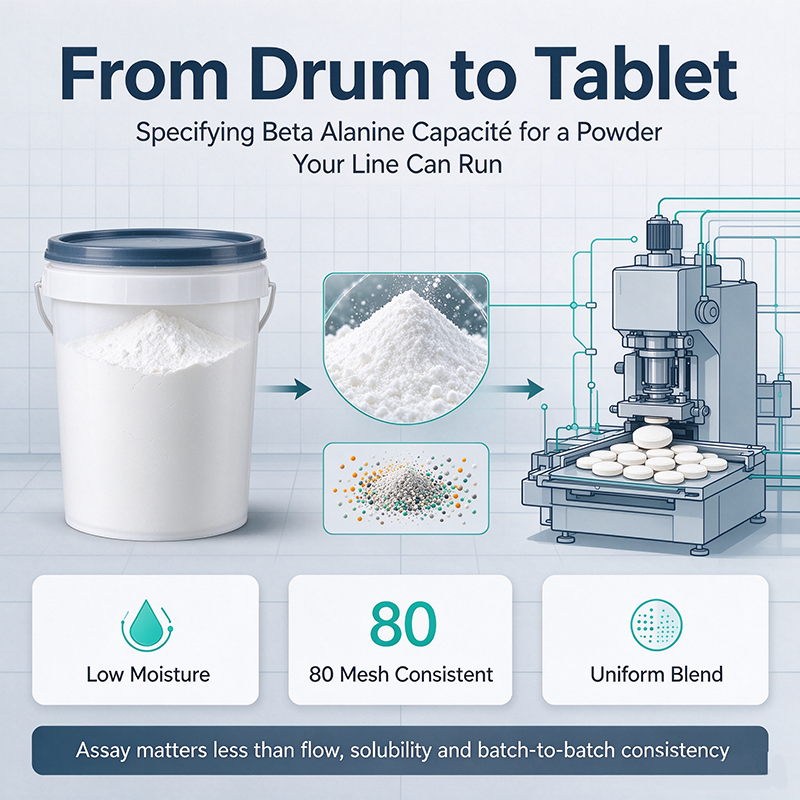
≥98.0% (HPLC/Titration) · USP/FCC/AJI · White crystalline powder · 80 mesh 100% through · TLC Conforms, beta isomer confirmed.
View product & spec →99% pure β-alanyl-L-histidine — the finished intramuscular buffer, ready to formulate without the loading wait.
View product & spec →When you request a quote for beta alanine capacite, our reply leads with the parameters that protect your formula — not a factory photo. We list:
That is the kind of "capacity" a French or European buyer should actually be screening for — and the part a tonnage number never tells you.
As a China-based beta-alanine supplier, we back the above with full documentation and a real beta-isomer confirmation on every lot. Send us your RFQ — tell us your target grade (IR powder, micronized, or finished L-carnosine) and we will return a specification you can formulate against.
Request a sample or quote →Full COA per batch, flexible MOQ and competitive pricing available — request a sample or quote. (Factory audits, certifications and pricing are handled separately and do not define product activity.)