• Alice Wang
• Whatsapp: +8613379289277
• Email: info@ceresherb.com
• Products Categories: Dietary Supplement Ingredients
You have a hair-care brief and two copper peptides on the table. They share the same copper–histidine–lysine core and differ by one amino acid at the N-terminus. That single residue is why formulators do not regard them as interchangeable — and why the application, not the price list, should decide which one goes into the formula.
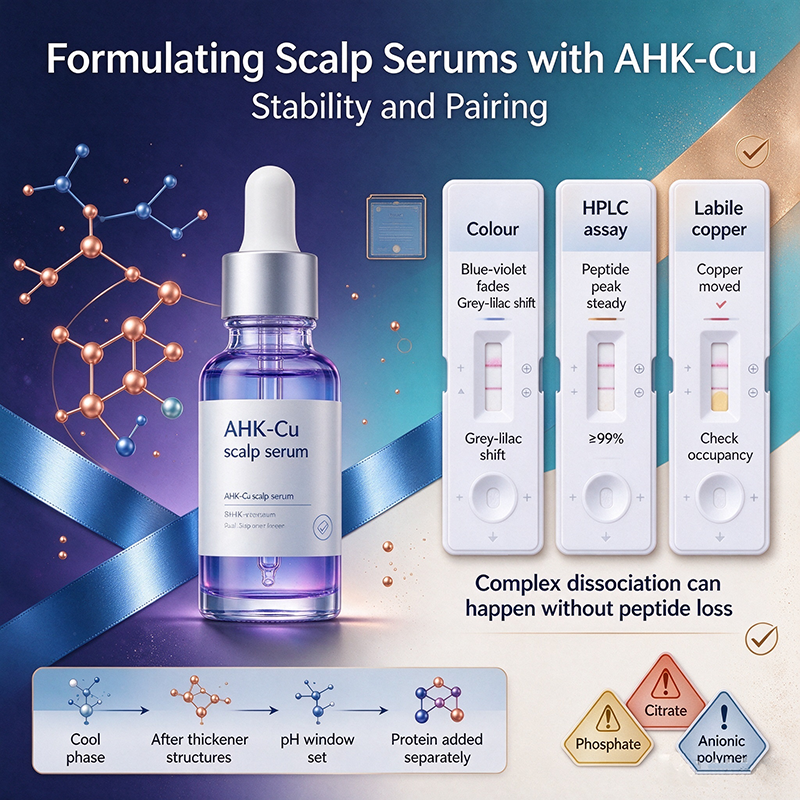
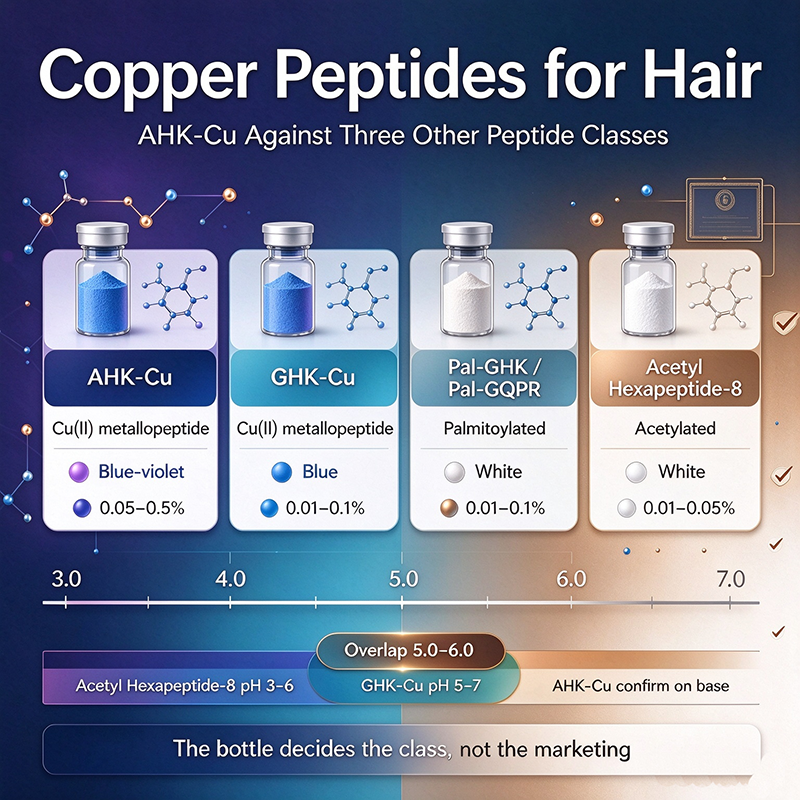
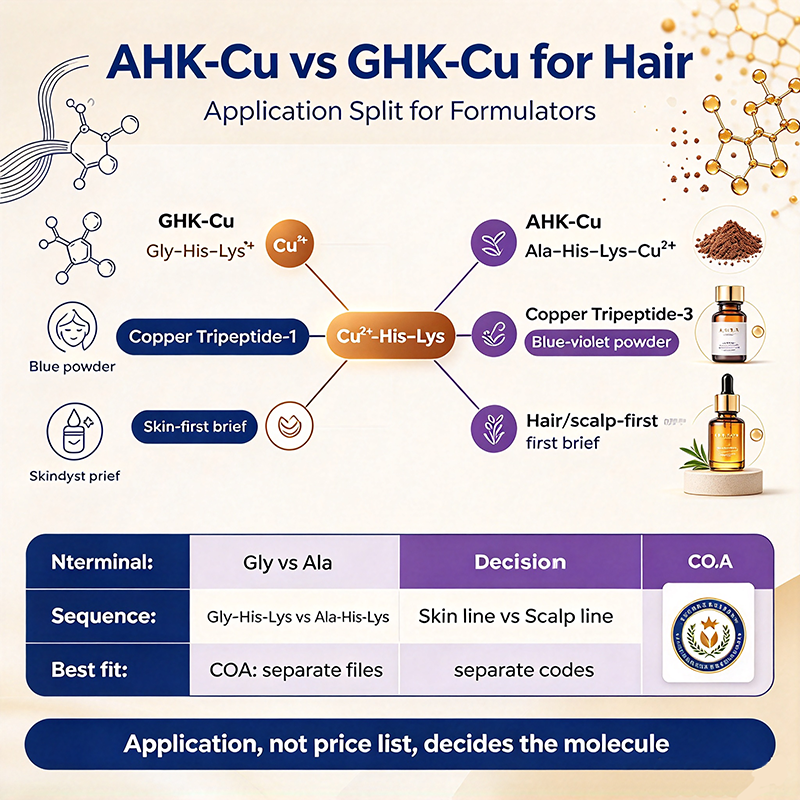
GHK-Cu is glycyl-L-histidyl-L-lysine copper complex — Gly–His–Lys–Cu²⁺, listed as Copper Tripeptide-1. AHK-Cu is L-alanyl-L-histidyl-L-lysine copper complex — Ala–His–Lys–Cu²⁺, listed as Copper Tripeptide-3. The copper center and the histidine–lysine backbone are the same; the only change is the first amino acid, where alanine replaces Glycine. That is a small structural edit with a practical consequence: the two peptides have different research histories and different natural placements in a hair-care range.
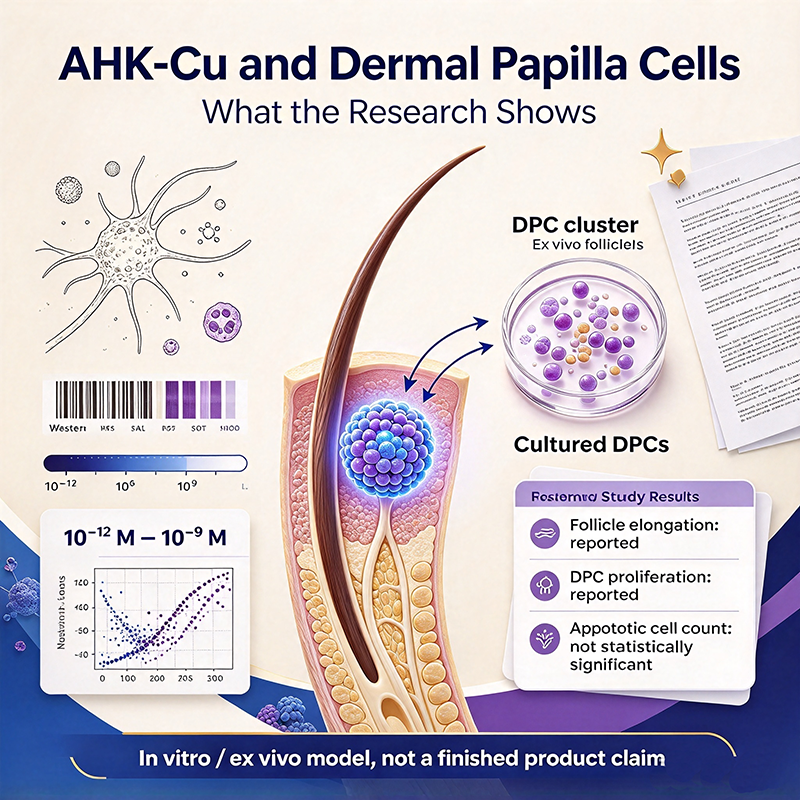
For AHK-Cu, the most direct hair-follicle work is a published study that evaluated L-alanyl-L-histidyl-L-lysine-Cu²⁺ on human hair follicles studied ex vivo and on cultured dermal papilla cells — the specialized fibroblasts at the base of the follicle. The work reported stimulation of follicle elongation and proliferation of dermal papilla cells at specific concentrations (Pyo et al., 2007; PubMed 17703734).
For GHK-Cu, the research base is broader and more skin-oriented, but it is not absent from hair. A GHK-containing complex — 5-aminolevulinic acid plus GHK peptide, not pure GHK-Cu — has also been examined in a hair-context study (Lee et al., 2016; PubMed 27489425). The distinction matters: if you cite the hair work for GHK-Cu, cite it accurately as work on a GHK-containing complex, not as pure GHK-Cu.
Both bodies of work are laboratory and ex vivo observations. How a finished product is positioned is the brand's responsibility, and we are not making an efficacy claim here. What the literature gives you is a sourcing signal: for a hair-first brief, AHK-Cu is the peptide whose published hair-follicle work is most direct.
Translate the research into the brief in front of you:
| Decision point | GHK-Cu | AHK-Cu |
|---|---|---|
| N-terminal residue | Glycine | Alanine |
| Sequence | Gly–His–Lys–Cu²⁺ | Ala–His–Lys–Cu²⁺ |
| Common name | Copper Tripeptide-1 | Copper Tripeptide-3 |
| Appearance | Blue powder | Blue-violet powder |
| Most direct hair-follicle work | GHK-containing complex in a hair-context study | AHK-Cu on ex vivo follicles and dermal papilla cells |
| Best-fit brief | Skin-first, hair secondary; single-peptide sourcing | Hair/scalp-first |
| Where it goes | Skin serums and creams; hair line extension | Scalp serums, leave-in, hair masks |
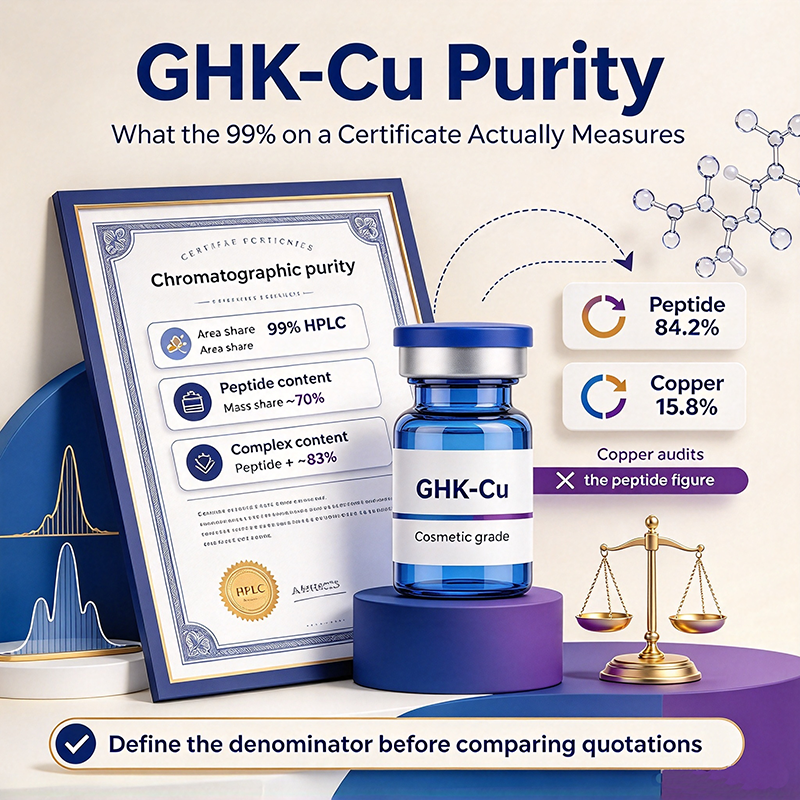
Because the two peptides are different molecules, one spec sheet cannot cover both. For either material, ask for the parameters that protect the finished formula:
If you run both peptides, keep two COA files and two internal material codes. A shared file is how a hair line ends up documented with the skin peptide's specification.
Before you commit a purchase order, put both samples through the same base. Use the same emulsifier, the same pH window and the same packaging, then compare color, dispersion, odor and stability across your intended shelf life. Keep the evaluation blind if your lab can. The point is not to declare one peptide "better" — it is to see which one behaves in the format you are actually selling, and to match that behavior to the brief you can defend on the label.
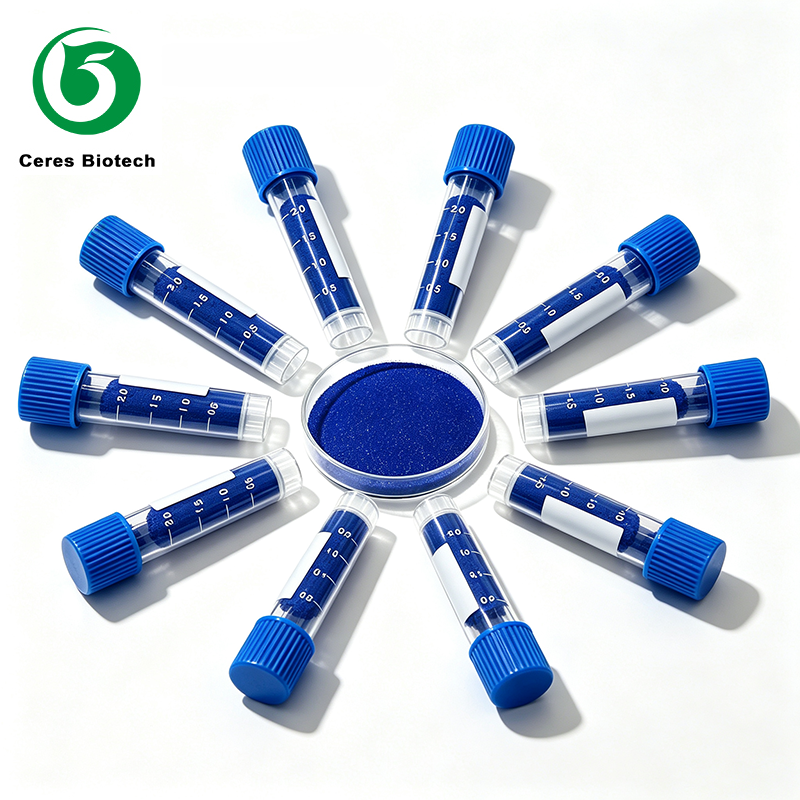
Cosmetic-grade AHK-Cu (L-alanyl-L-histidyl-L-lysine copper complex). Blue-violet powder, 99% purity, for scalp serums, leave-in products and hair masks.
View product & spec →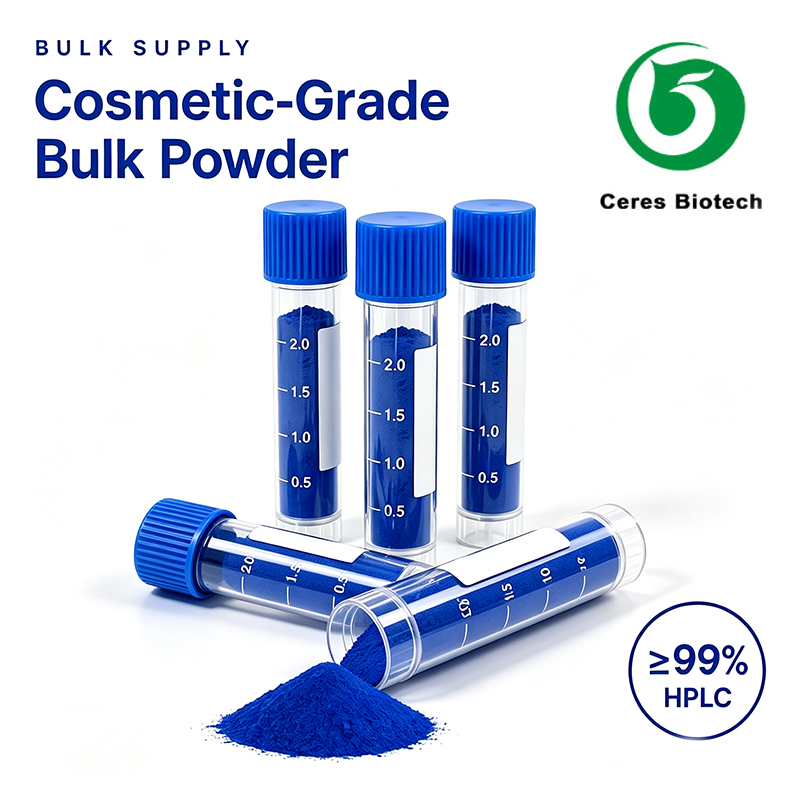
Cosmetic-grade GHK-Cu (glycyl-L-histidyl-L-lysine copper complex). Blue powder, 99% HPLC purity, for skin serums and creams with a hair line extension.
View product & spec →As a China-based supplier of both AHK-Cu and GHK-Cu, we supply each peptide with its own per-batch COA, so your hair line and skin line stay documented separately. Send us your RFQ — tell us whether the brief is hair-first or skin-first, your target purity, and your format (scalp serum, leave-in, cream or mask), and we will return the matching specification.
Request a sample or quote →Full COA and MSDS per batch, flexible MOQ and competitive pricing available — request a sample or quote. (Factory audits, certifications and pricing are handled separately and do not define product activity.)