• Alice Wang
• Whatsapp: +8613379289277
• Email: info@ceresherb.com
• Products Categories: Dietary Supplement Ingredients

You ordered AHK-Cu cosmetic grade powder at 99%, and the certificate came back with one line: purity ≥99.0% by HPLC. That figure describes the peptide. It says nothing about whether the copper is still attached to it. Three measurements, not one, define this material — and the gaps between them are where a specification either holds up or quietly falls apart.
AHK-Cu is a coordination complex, not a plain peptide. A tripeptide — alanine, histidine, lysine — wraps around a copper(II) ion and holds it in a defined geometry. Two components, one molecule, one set of properties. Every specification question about it therefore has two halves, and a certificate that reports only chromatographic purity has documented the organic half.
This is not one company's failing so much as a category habit. In a 2026 systematic review of copper-peptide coordination chemistry and formulation science, the authors observe that studies routinely report total peptide and copper content while molar occupancy and labile copper are usually left unresolved. In other words: the field is good at saying how much peptide and how much copper are in a sample, and poor at saying how much of the peptide is actually carrying copper. When you specify AHK-Cu cosmetic grade powder, the second question is yours to ask.
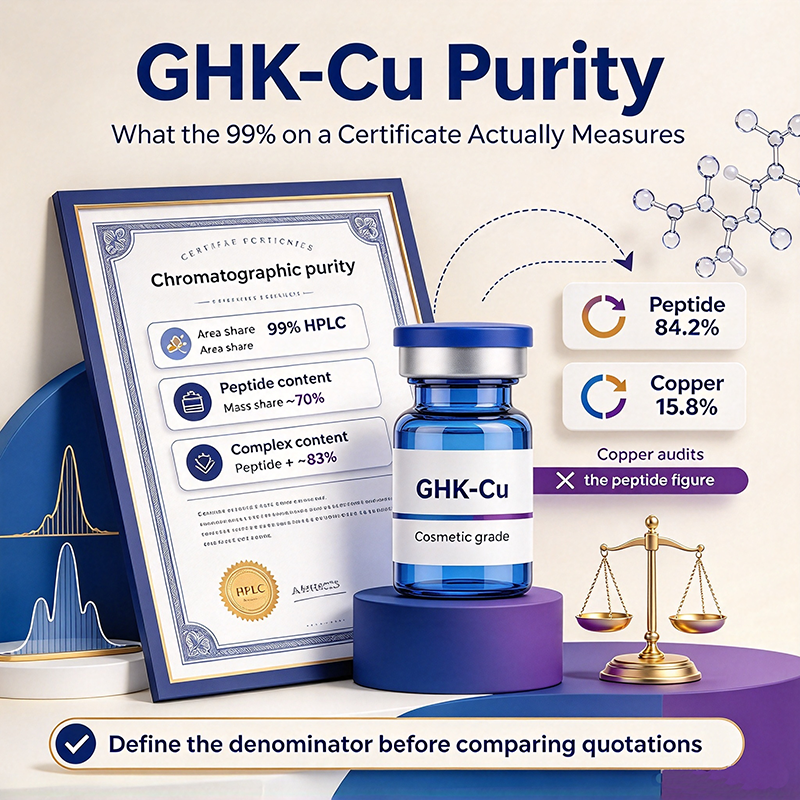
HPLC purity is an area percentage. Your method separates the sample on a column, a detector watches the eluent at a set wavelength, and the software reports the share of total integrated signal that belongs to the main peak. ≥99.0% is a tight result — it means the target peak dominates everything else the detector saw.
What the detector did not see is the important part. Area percentage covers what elutes and absorbs. Water does not. Residual salts and counter-ions do not. Solvent residue does not. This is precisely why a serious specification carries loss on drying and heavy metals as their own rows rather than folding them into the purity figure — if the percentage accounted for everything in the drum, those rows would be redundant.
Nor does 99% state the copper stoichiometry. The intact complex and the copper-free peptide are different molecules and should separate under a method built for the complex, so a chromatogram can show you that one main species is present. It cannot, on its own, tell you what fraction of that species is metal-loaded. That is a separate assay, and it is the next row on the certificate.
Our AHK-Cu grade states copper (Cu²⁺) content as 8.0–12.0%, measured by a metal-specific method — not by the HPLC. Read the two numbers together and you finally have both halves of the material: the peptide is ≥99.0% pure, and the metal is present within a declared band.
The question worth putting on your RFQ is not only what is the copper figure, but which method produced it, and on what basis. ICP-OES and complexometric titration will both give you a copper number; they do not have the same selectivity, and an as-is result differs from a dried-basis result on a powder permitted up to 5.0% moisture. If the answer is "the certificate says 10%", you cannot compare that lot against a second source, and you cannot trend your own incoming lots across a year. A number without a method is a rumour with decimals.
Mass spectrometry closes the loop. Our per-batch certificate covers HPLC and MS identity, and the mass that matters is the molecular ion of the intact complex rather than of the peptide alone.
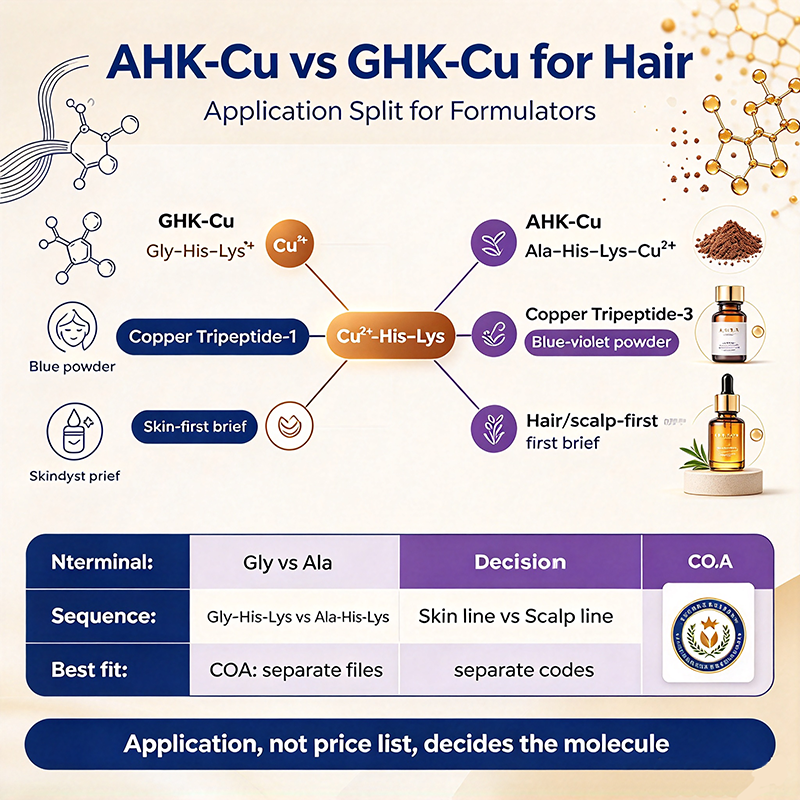
For reference, the molecule is the L-alanyl-L-histidyl-L-lysine copper(II) complex, sold as Copper Tripeptide-3:
An MS result at that mass is evidence that the peptide and the copper are in the same molecule, not merely in the same bag. Purity ≥99.0% plus the correct molecular ion plus copper inside the declared band is what "AHK-Cu 99%" should mean in practice. Any one of the three on its own is a partial answer, and a certificate showing only the first is the most common way a hair-care brand ends up buying an unverified complex.
Here is the full specification of our AHK-Cu cosmetic grade, with the reason each row exists. This is the document to line your incoming goods check against — not a marketing summary of it.
| Item on the COA | Method | Specified | What a miss tells you |
|---|---|---|---|
| Identity | MS molecular ion + HPLC retention against reference | Complex confirmed | Wrong peptide, or copper-free peptide sold as the complex |
| Purity | HPLC, area % | ≥ 99.0% | Related peptides and degradation fragments in the lot |
| Copper (Cu²⁺) | Metal-specific assay — ask which one | 8.0–12.0% | Peptide present but not metal-loaded, or copper off-stoichiometry |
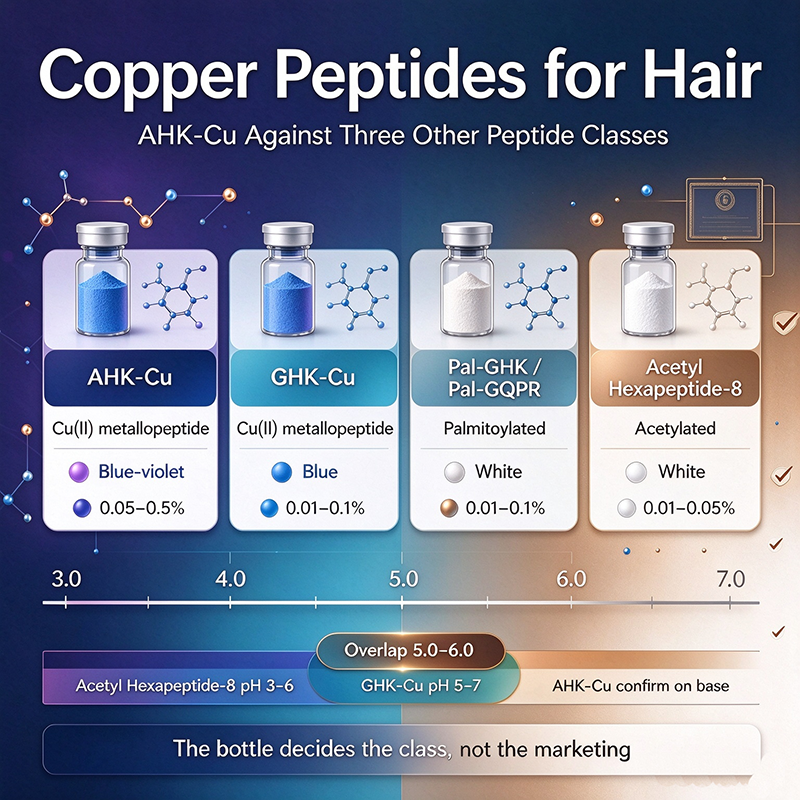
| Appearance | Visual | Blue to blue-violet fine powder | Grey, brown or patchy colour points to oxidation, moisture or breakdown |
| pH (1% solution) | pH meter | 6.0–8.0 | An off-pH lot shifts the base it goes into and complicates your own stability work |
| Loss on drying | Oven or Karl Fischer | ≤ 5.0% | You are paying peptide price for water, and moisture shortens shelf life |
| Heavy metals | ICP-MS | ≤ 10 ppm (Pb, As, Cd, Hg) | A safety gate — not negotiable against a discount |
| Microbiology | Plate count | TPC ≤ 1,000 CFU/g; yeast & mould ≤ 100 CFU/g; E. coli and Salmonella negative | Release gate for a cosmetic raw material |
| Solubility | Visual at working concentration | Water soluble, ≥ 100 mg/mL | A lot that clouds or leaves undissolved matter will not give you a clear serum |
| Recommended use level | — | 0.05–0.5% (500–5,000 ppm) | Not a release test; the starting range for your own dose-finding |
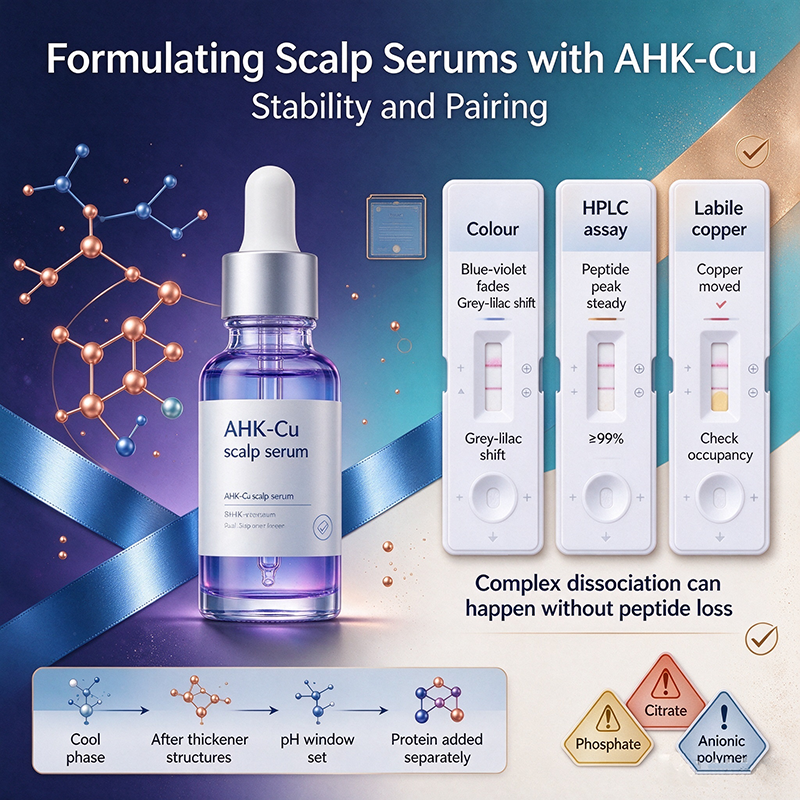
The colour of this material comes from the copper–peptide chromophore, which is why our specification describes the shade as a quick visual cue that the powder is fully chelated. That framing is the correct one: a cue, not a number.
As a cue it earns its place. A grey, brown or unevenly coloured lot is worth stopping before you release it, because the usual causes are moisture ingress, heat exposure or a complex that has come apart — and all three are cheap to catch at goods-in and expensive to catch after a batch of serum has been filled.
What colour cannot do is quantify. A partly degraded lot can still be blue, because the chromophore survives while the peptide backbone does not; intensity also shifts with particle size and moisture content, so two lots of identical purity can look slightly different. Use the shade to decide whether to investigate. Use HPLC and MS to decide whether to release.
None of these replaces the certificate, and all three catch the failures that matter most at goods-in.
Storage is part of the specification: 2–8 °C, protected from light and moisture, 24-month shelf life, supplied for external topical use in cosmetic products. Inside those conditions the material will hold the numbers on the certificate.
What no certificate covers is how the complex behaves in your base. pH drift in the finished product, chelating agents, other actives in the same phase, the order of addition — those are formulation questions, and they are settled by stability work on your side rather than by a document from ours. Read the COA as the starting condition of that work, not as its conclusion.
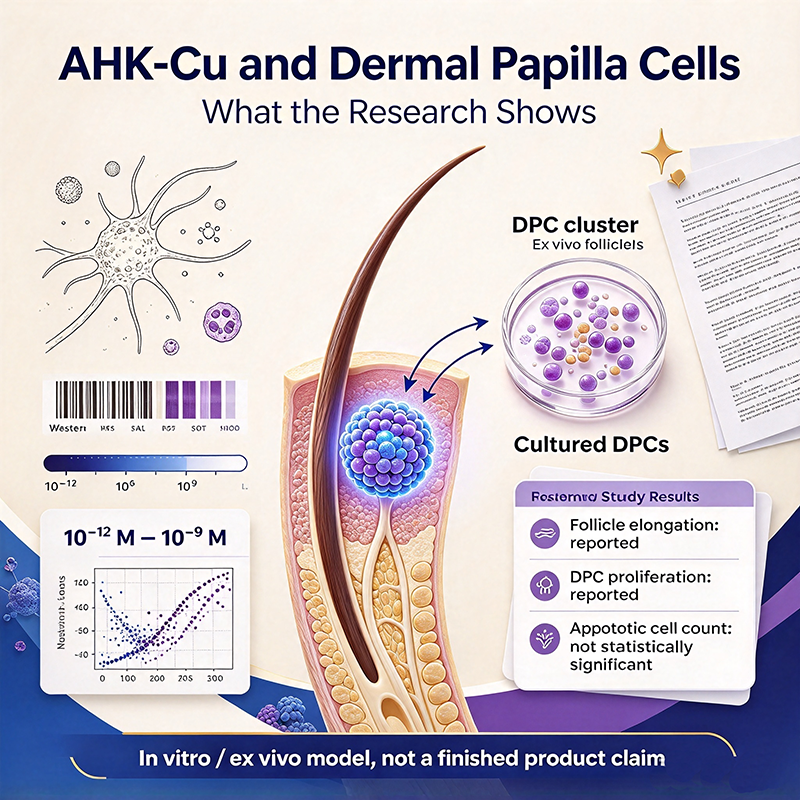
If you are at the specification stage rather than the formulation stage, the AHK-Cu cosmetic grade powder page carries the same panel in product form, and the research behind the hair positioning is set out in our brief on AHK-Cu and dermal papilla cells.
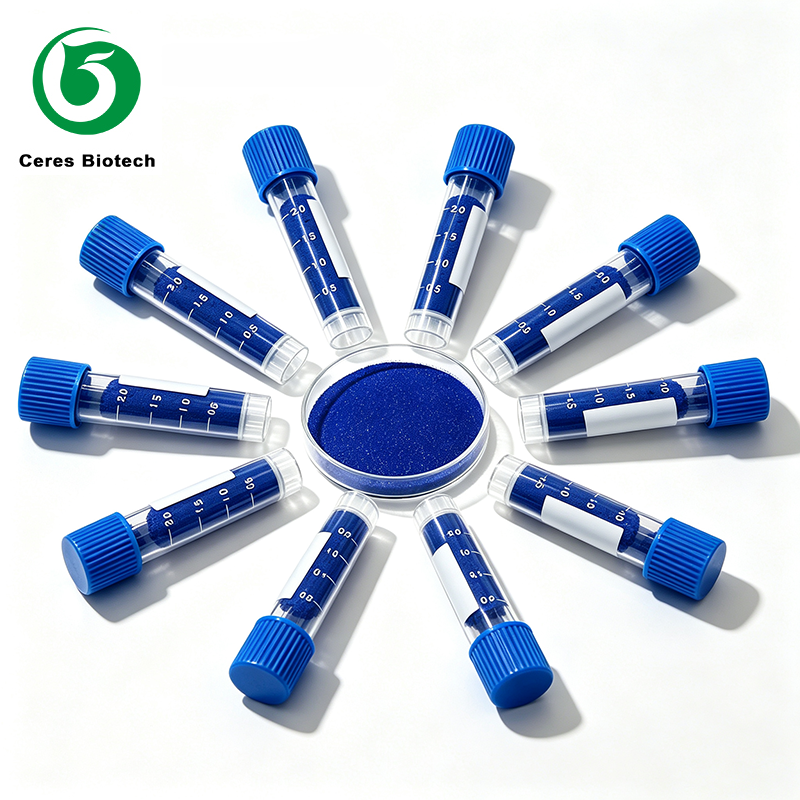
Blue to blue-violet fine powder, ≥99.0% by HPLC, Cu²⁺ 8.0–12.0%, water soluble ≥100 mg/mL. Supplied with a per-batch COA covering HPLC and MS identity.
View product & spec →As a China-based supplier of AHK-Cu, we issue a per-batch COA that states the HPLC purity, the copper figure with its method, and the MS identity of the complex — the three rows this article is about. Send us your RFQ and tell us the purity grade, the pack size and whether your specification template needs the copper basis stated as-is or on a dried basis; we will return a COA you can file against.
Request a sample or quote →Full COA and MSDS per batch, flexible MOQ and competitive pricing available — request a sample or quote. (Factory audits, certifications and pricing are handled separately and do not define product activity.)