• Alice Wang
• Whatsapp: +8613379289277
• Email: info@ceresherb.com
• Products Categories: Dietary Supplement Ingredients

Almost every AHK-Cu pitch in the hair-care category traces back to one paper. That is not a weakness — but it does mean you should know exactly what the paper did, at what concentrations, and which of its results held up statistically. Here is the study on AHK-Cu and dermal papilla cells, read line by line, so you can see where the evidence ends and the marketing begins.
Dermal papilla cells (DPCs) sit in a cluster at the base of each hair follicle, wrapped by the bulb. They are fibroblasts by lineage but not ordinary ones: the follicle's own morphogenesis and growth depend on them, which is why any ingredient aimed at the follicle eventually gets tested against DPCs rather than against skin fibroblasts.
That distinction matters when you read the literature. Work on the copper tripeptide family describes the complex as stimulating dermal fibroblast proliferation and raising vascular endothelial growth factor output, while lowering transforming growth factor-β1 secretion by those fibroblasts. AHK-Cu research takes a different target — the follicle itself and the DPC population inside it. If a page quotes fibroblast data at you while selling a hair ingredient, the model does not match the claim.
The primary reference for AHK-Cu in hair is Pyo et al., published in Archives of Pharmacal Research in 2007 (PubMed 17703734). The AHK-Cu dermal papilla cells literature is short enough to read in an afternoon — which is exactly why the details matter. The authors were at the Department of Dermatology, Seoul National University College of Medicine. Two models were used, and this is the part worth memorising:
Ex vivo follicles are a stronger model than a cell line because the follicle keeps its architecture. They are still not a person: nothing in this design involves a scalp, a rinse-off, or a leave-on product.
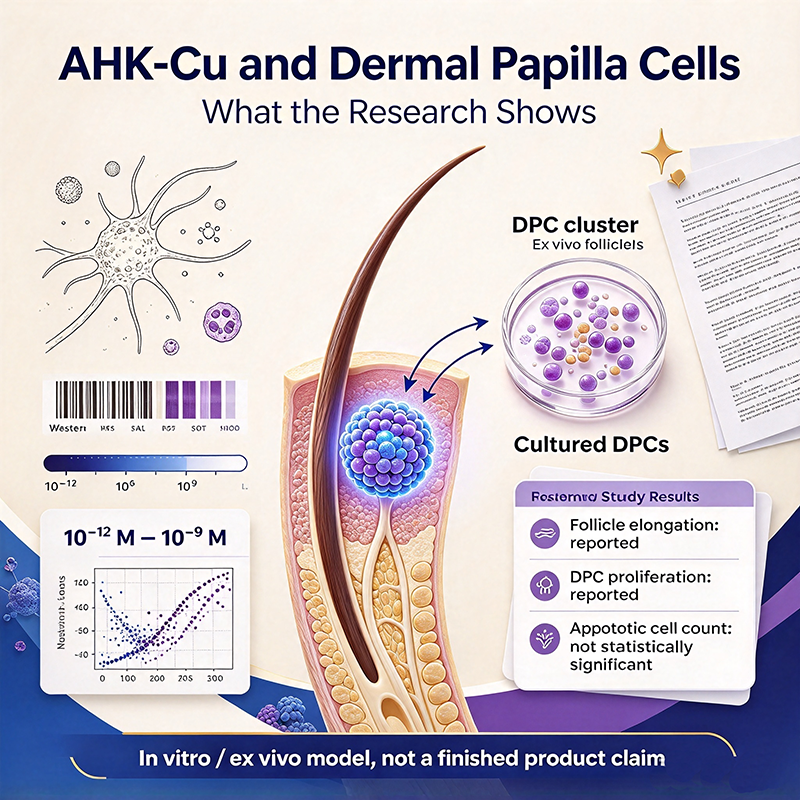
AHK-Cu was tested across 10⁻¹² to 10⁻⁹ M — picomolar to nanomolar, an unusually wide span for a peptide screen. Within that window the study reports two positive findings: stimulated elongation of human hair follicles ex vivo and stimulated proliferation of cultured dermal papilla cells. Both are described as concentration-dependent within the tested range.
The cell-death side of the study is more textured. At 10⁻⁹ M, AHK-Cu reduced the number of apoptotic DPCs measured by annexin V–FITC / propidium iodide labelling and flow cytometry — but the authors state plainly that this decrease was not statistically significant. What did move was the marker pattern: the Bcl-2/Bax ratio was elevated, and the levels of cleaved caspase-3 and cleaved PARP were reduced.
That split — markers shifting while the cell count does not — is the most useful sentence in the paper for anyone buying the ingredient. It means the apoptosis arm of the study generated a hypothesis, not a demonstrated effect. When a product page tells you AHK-Cu "protects the follicle", that is a reading of the Western blot, not of the flow cytometry data.
The authors' own conclusion is measured: AHK-Cu promotes follicle elongation, and the effect may occur through stimulation of DPC proliferation and reduced apoptosis. "May" is doing real work in that sentence. Any version of the story that drops it is overselling what a single 2007 in vitro study can carry.
| Model | Endpoint | Concentration | Reported result |
|---|---|---|---|
| Human hair follicles, ex vivo organ culture | Follicle elongation | 10⁻¹² – 10⁻⁹ M | Elongation stimulated |
| Cultured human dermal papilla cells | Proliferation | 10⁻¹² – 10⁻⁹ M | Proliferation stimulated |
| DPCs, annexin V–FITC / PI flow cytometry | Number of apoptotic cells | 10⁻⁹ M | Reduced — not statistically significant |
| DPCs, apoptosis markers | Bcl-2/Bax ratio; cleaved caspase-3; cleaved PARP | 10⁻⁹ M | Ratio elevated; cleaved forms reduced |
Two limits are worth putting in front of your product team before the artwork is signed off.
First, an in vitro molar concentration is not a use level. The study worked in the picomolar to nanomolar range in culture medium. You cannot back-calculate a percentage for a scalp serum from that number — the two systems differ in delivery, residence time, pH, and what actually reaches the follicle. Any page that converts 10⁻⁹ M into a recommended dose is inventing a bridge the paper does not build.
Second, the model stops at the dish. No scalp, no rinse-off, no finished formulation, no clinical endpoint appears in this design. That does not make the finding weak — ex vivo human follicles are a legitimate and fairly demanding model. It does mean the honest description of your product is "contains a copper tripeptide studied in ex vivo human follicles and cultured dermal papilla cells", not "shown to grow hair".
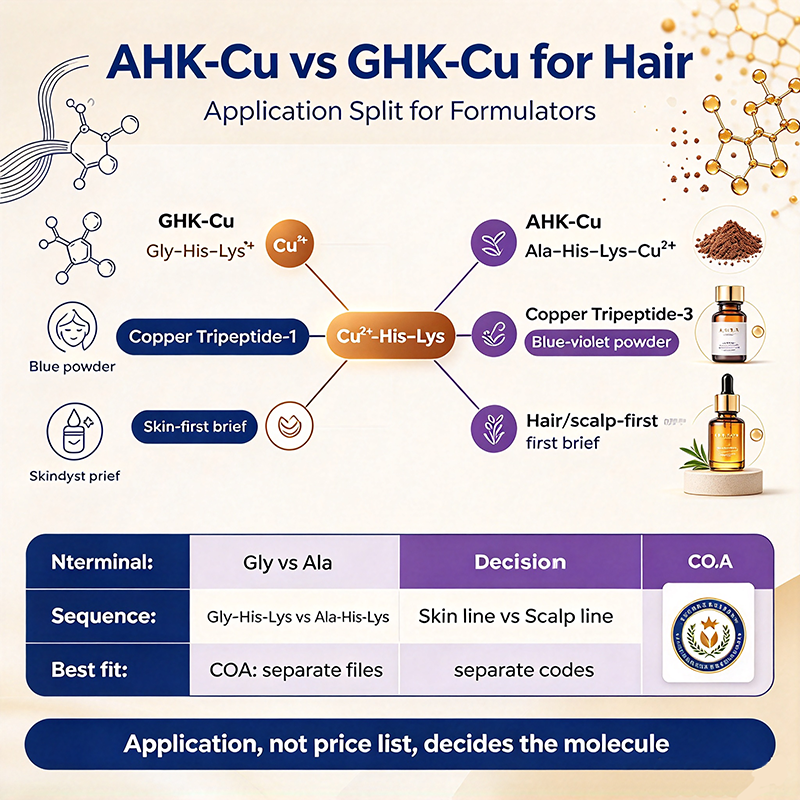
What you can legitimately use the paper for is positioning: it is the reason AHK-Cu sits in the hair-and-scalp category rather than in a general skin range, and it is a defensible citation for a formula brief that names the follicle as its target. See the AHK-Cu cosmetic grade specification for the material side of that brief.
The study tells you what the molecule can do in a dish. It tells you nothing about whether the drum you receive contains that molecule. Ask for:
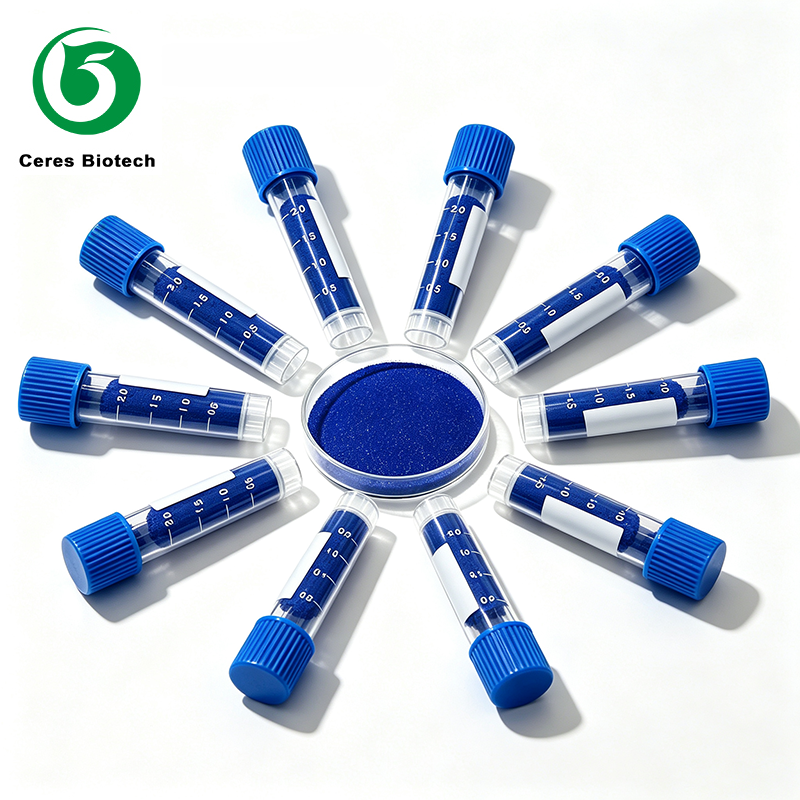
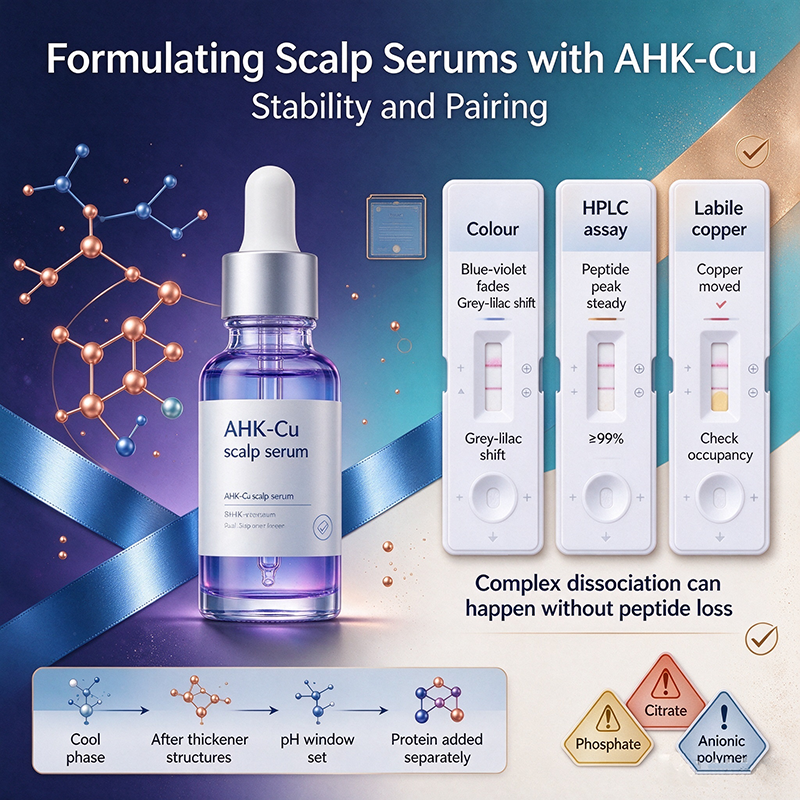
Blue-violet powder, 99% assay, cosmetic grade. L-alanyl-L-histidyl-L-lysine copper complex for hair and scalp care formulas, with per-batch COA.
View product & spec →As a China-based supplier of AHK-Cu, we ship the 99% cosmetic grade with a per-batch COA and the identity documentation your regulatory file will ask for. Send us your RFQ — tell us your target concentration range, your format (scalp serum, leave-in, mask) and whether you need AHK-Cu on its own or alongside GHK-Cu for a two-line range, and we will return a specification you can formulate against.
Request a sample or quote →Full COA and MSDS per batch, flexible MOQ and competitive pricing available — request a sample or quote. (Factory audits, certifications and pricing are handled separately and do not define product activity.)